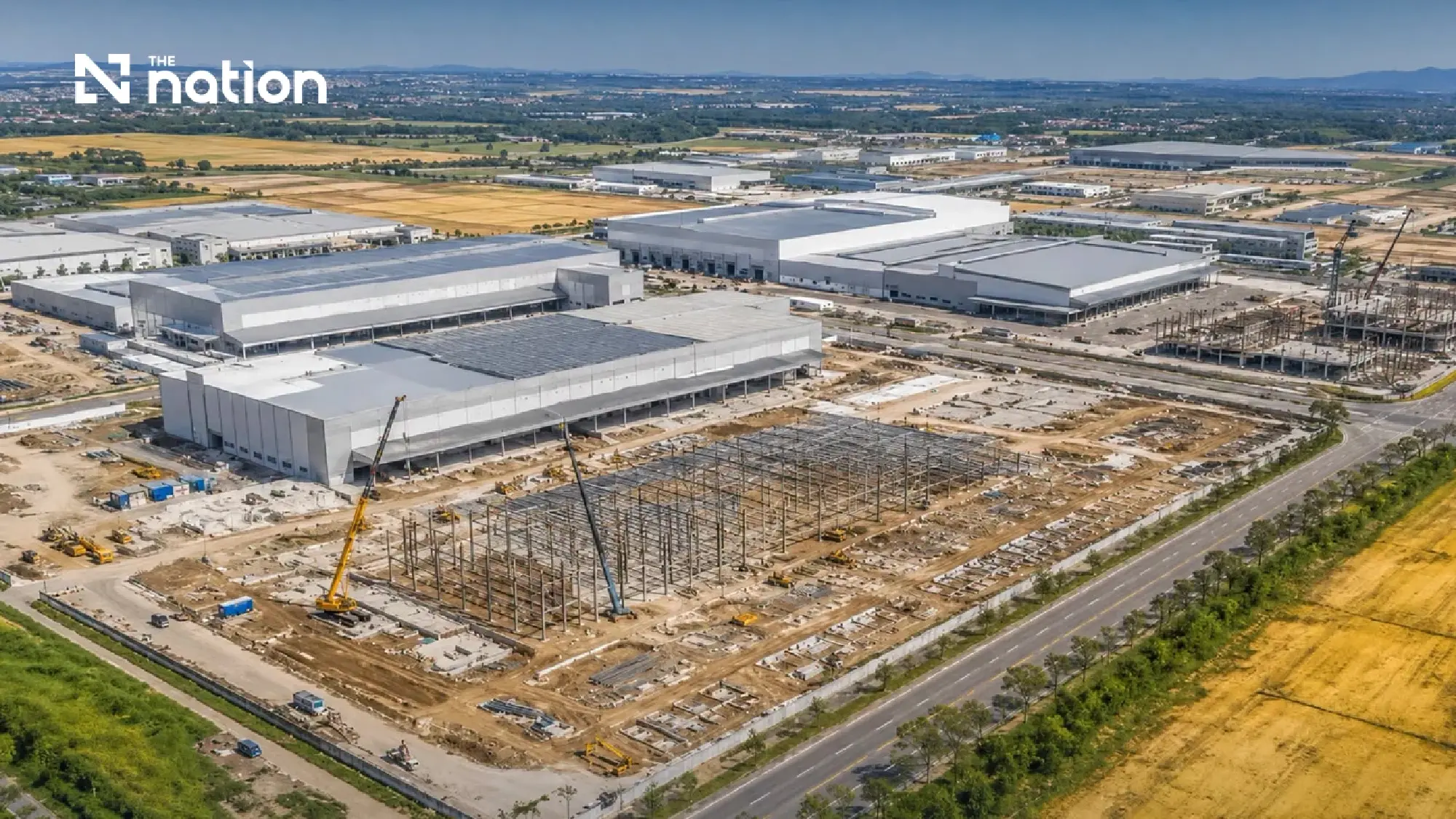
Concerns over Chinese industrial parks, land acquisition and zoning compliance grow in Thailand’s EEC as BOI clarifies rules and oversight
Concerns are growing over Chinese investment in Thailand's Eastern Economic Corridor (EEC), particularly regarding large-scale land acquisition for industrial development.
A key case, the Hengtu Industrial Park in Chon Buri, is under scrutiny for being developed on land zoned for rural and community use, which legally prohibits such industrial operations under EEC land-use rules.
The project's significant requests for infrastructure, such as 300 megawatts of electricity, have intensified questions from stakeholders about its regulatory approval and legal compliance.
The situation highlights broader fears about regulatory gaps, weak enforcement of zoning laws, and the potential for foreign capital to dominate strategic assets without sufficient oversight.
Rising concerns over Chinese investment and land control in Thailand
Concerns are emerging over what industry voices describe as “unusual signals” from Chinese investment activity in Thailand, including land acquisition, industrial estate development and potential consolidation in strategic economic zones such as the Eastern Economic Corridor (EEC).
While investment from China is not seen as inherently problematic, stakeholders emphasise that it is acceptable only when it creates value-added economic activity, technology transfer and tangible benefits to Thailand’s economy.
However, they warn that a more serious issue lies in regulatory enforcement gaps, including questions over transparency, nominee arrangements and access to national resources without sufficient oversight.
Land price pressure and structural economic concerns
Thailand is currently experiencing rapid increases in land prices across multiple regions, while many local entrepreneurs face rising costs that are eroding competitiveness.
Large-scale land acquisition, aggregation of plots and development linked to foreign capital networks are seen as reshaping local economic structures in significant ways.
This has raised concerns about whether economic benefits are flowing back to Thai society, or whether the system is gradually shifting toward one dominated by foreign capital, foreign labour and external supply chains, reducing domestic economic circulation.
Hengtu Industrial Park investment and EEC activity
A key case under scrutiny is Hengtu Industrial Park Co., Ltd., which has reportedly begun seeking infrastructure support such as water and electricity as it moves ahead with investment activity.
According to Department of Business Development records, the company was established with a registered capital of 5 million baht and operates as a real estate brokerage entity.
It is developing the Hengtu Industrial Park, located in Tha Thong subdistrict, Bo Thong district, Chon Buri.
The land area is estimated at around 1,000 rai, with reports suggesting that accumulated land holdings in the wider project area could reach up to 5,000 rai.
Zoning controversy over “light yellow” land classification
The project area falls under Chor Bor (light yellow) land classification, designated for rural community use, social services and local economic development under the EEC land-use plan announced in 2019.
Under this zoning category, land is intended for residential and community purposes, not for industrial development that could significantly impact the environment, natural resources or public health.
Industry sources note that such zoning prohibits land allocation for industrial operations under land subdivision laws, raising questions about whether industrial park-style development is legally permissible in this zone.
The project has reportedly submitted requests for electricity supply of around 300 megawatts, a level comparable to large-scale industrial estates.
This has prompted questions among stakeholders about grid capacity, regulatory approval and potential impacts on surrounding communities.
On water supply, the project has reportedly coordinated with Y.S.S.P. Aggregate Co., Ltd., a company involved in water resource development and management, to support industrial operations across approximately 1,000 rai.
However, the arrangement has not been finalised due to unclear regulatory status regarding the industrial park’s legal classification.
Industry sources questioned whether such large-scale water usage has proper licensing and what the total demand would be if the project expands to full capacity.
BOI clarification: Huanya Electronics investment
Amid the broader concerns, another Chinese-linked company, Huanya Electronics (Thailand) Co., Ltd., has been identified as receiving investment promotion from the Board of Investment (BOI).
The company was approved on 16 October 2024 for LED lighting and electrical appliance manufacturing, with a total investment of 20 million baht.
However, BOI Secretary-General Narit Therdsteerasukdi clarified that the Hengtou Industrial Park project itself is not under BOI promotion and has no formal connection to the agency.
He added that industrial estate development requires majority Thai shareholding and must receive approval from relevant authorities before operations can proceed.
BOI: incentives do not override other laws
The BOI emphasised that investment promotion does not grant exemptions from other legal frameworks.
Companies receiving BOI privileges are only entitled to specific benefits such as exemption from import duties on machinery and raw materials.
They do not receive corporate income tax exemption in this case, nor do they gain land ownership rights.
All promoted companies must still comply with zoning laws, factory regulations, environmental laws and other applicable legal requirements.
Enforcement responsibilities and regulatory oversight
Authorities stressed that after investment approval, the BOI continues to monitor compliance and may issue warnings, suspend privileges or revoke incentives if companies fail to meet legal conditions.
Industry sources also noted that responsibility for verifying factory licensing (Ror Ngor 4 permits) lies with the Department of Industrial Works or provincial industrial offices, particularly in Chon Buri.
They emphasised that even if industrial parks do not require direct approval from the Ministry of Industry, all developments must still comply with land-use zoning laws and factory regulations.
Legal restrictions on industrial activity in zoning area
Under current regulations, land classified as Chor Bor (light yellow) cannot be used for industrial estate development under land allocation laws.
It is also restricted from hosting industrial activities that may create severe environmental, natural resource or health impacts on nearby communities.
However, some industrial activity may still be permitted depending on classification and environmental impact assessment, though strict limitations apply.
Broader concerns over regulatory gaps and governance
Industry observers argue that Thailand is facing a broader governance challenge in managing foreign investment flows, particularly in strategic sectors such as land, energy and industrial development.
Concerns include nominee structures, land accumulation, regulatory fragmentation and the potential misuse of investment incentives.
Stakeholders warn that while foreign investment remains essential for growth, the absence of strong regulatory “filters” could create long-term structural risks for Thailand’s economy.
Call for stronger state oversight
Critics argue that Thailand must shift its role from a passive “approval authority” to an active regulator capable of monitoring investment behaviour more closely.
They stress that development should not result in situations where Thai citizens become “tenants in their own country” due to unchecked foreign capital dominance in strategic assets.
Without stronger enforcement, they warn, Thailand risks losing control over land, resources and economic opportunities over the long term.