
Thailand’s AI Edge Lies In Complex Hardware, Not Frontier Models, KKP Says
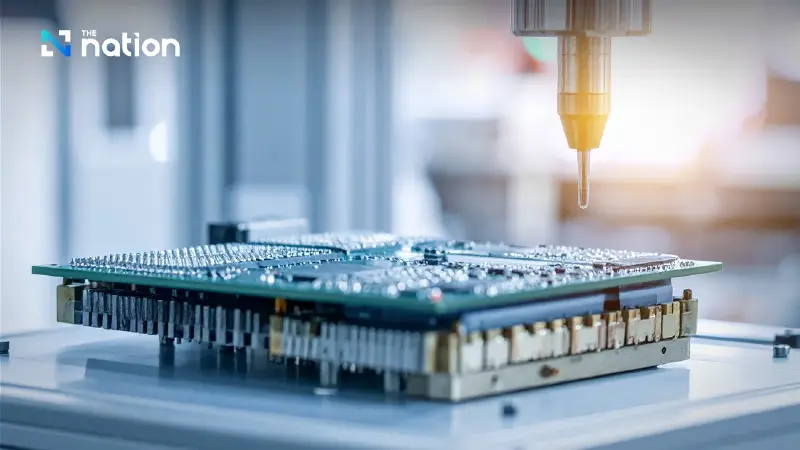


As AI shifts from data centres to satellites, smart cars and humanoids, Thai makers eye high-value parts, though talent and geopolitics pose hurdles
- According to Kiatnakin Phatra Securities (KKP), Thailand's competitive advantage in the AI sector lies in its established manufacturing base for producing high-value, complex hardware components, not in developing frontier AI models.
- The demand for this advanced hardware is driven by global trends in satellite communications, the increasing electronic content in smart vehicles, and the emerging market for humanoid robots.
- Thailand is positioned to benefit from geopolitical supply-chain diversification, as global companies seek production capacity outside of China for sensitive components used in defense and national security.
- Despite the opportunity, the country faces hurdles such as competition from regional neighbors in chip-making and the need to upgrade its workforce's technological skills to meet global standards.
As AI shifts from data centres to satellites, smart cars and humanoids, Thai makers eye high-value parts, though talent and geopolitics pose hurdles.
Thailand does not need to build the world’s leading artificial intelligence models to capture meaningful gains from the next wave of AI, as its established manufacturing base positions the country to supply complex components for real-world devices, analysts at Kiatnakin Phatra Securities (KKP) said on Wednesday.
Speaking at a KKP media briefing on November 25, 2026, equity analysts Suppapong Iemkongaek and Sarachada Sornsong argued that global AI investment—which has exceeded US$1 trillion on data centres and processing chips to build AI’s “brain”—is moving into a phase where intelligence is deployed into physical systems that connect, sense, decide and act.

Rather than competing on sheer volume against China, Thailand’s competitive strength lies in producing high-complexity hardware such as printed circuit boards (PCBs), power management systems and assembly components for satellites, smart vehicles and humanoid robots.
“Thailand may not need to be the country that creates the best AI model in the world to benefit from this change,” Suppapong said. “What we already have is a manufacturing base. Today, parts from Thailand may be in cars, but in the future, parts from the same factory could go onto satellites or into robots. That is the opportunity we see as interesting.”

Three Shifts Reshaping Hardware Demand
KKP highlighted three global technology trends driving demand for higher-value electronics:
• Satellite communications: Direct-to-device satellite connectivity has begun commercial rollout in markets such as the Philippines for messaging and mapping in coverage dead zones.
Citing Bank of America (BofA) estimates, KKP noted that SpaceX connectivity revenue—including Starlink—is projected to grow at an average annual rate of 60% between 2025 and 2031 (BE 2568–2574), rising from about US$11.4 billion to nearly US$190 billion, lifting demand for complex, high-frequency communications boards and hardware.
• Smart vehicles: Even if global light-vehicle production edges down 1.2% in 2026 (BE 2569) to roughly 91.3 million units, advanced driver-assistance systems (ADAS), in-cabin screens and vehicle computing are raising electronic content per car—from around US$50–US$60 historically to roughly US$100 for PCBs in certain premium models today, allowing Thai manufacturers to gain from higher value per vehicle rather than volume alone.
• Humanoid robots: Global development of humanoid robots is accelerating, with BofA projecting sales could reach around 1.2 million units by 2030 (BE 2573) and create a US$100 billion market by 2033 (BE 2576), offering supply-chain entry points for component makers even without building complete robots.

Opportunities, Tailwinds and Structural Challenges
Geopolitical supply-chain diversification—often termed “China+1” or “Taiwan+1”—is reinforcing Thailand’s push up the value chain. Because sensitive applications spanning defence, satellites and national security face restrictions on Chinese sourcing, global customers are adding production capacity outside China, creating openings for Thailand alongside existing strengths in industrial estates, logistics and supplier networks.
Board of Investment (BOI) applications in the digital and electronics sector doubled from roughly 700 billion baht in the first half of 2025 (BE 2568) to 1.4 trillion baht in the first half of 2026 (BE 2569), accounting for 80% of total BOI applications in that period.
Electronics exports already represent a major macroeconomic pillar, accounting for more than US$73 billion, or 22% of total exports in 2025, and rising to a 27% share in the first nine months of this year, while electronics equipment exports contributed about 12.6% of Thailand’s GDP last year.
Suppapong also pointed to a distinction between a temporary hardware cycle and a structural shift.
Past booms, such as pandemic-driven work-from-home demand, cooled once restrictions eased, whereas AI integration across workflows and devices is more likely to represent a multi-year structural trend—while still carrying execution and adoption risks if emerging applications like humanoid robotics or autonomous driving take longer to scale.

At the same time, KKP stressed that Thailand faces clear hurdles. Neighbouring Malaysia holds an advantage in wafer fabrication and chip-making scale due to earlier state support, while Thailand remains a downstream and supply-chain participant rather than an upstream chip or AI model leader in the near term.
Export controls on advanced chips and licensing rules can delay shipments or affect where data centres are built, weighing on sentiment for industrial estates and power utilities if foreign political restrictions tighten.
Meanwhile, new electric vehicle tax rules and EV localisation commitments—including mandatory domestic production to meet government incentive conditions next year—add near-term policy variables alongside ongoing negotiations.
To convert opportunities into sustainable earnings, KKP said Thai companies must move beyond capacity expansion to strengthen technological readiness, meet strict global customer standards, develop a skilled workforce and deepen domestic supply chains for advanced electronics.
Stock Market Implications
Within the equity market, KKP views the AI hardware shift—and recent pullbacks from earlier rallies—as offering selective buying opportunities for companies with sound fundamentals, favouring component makers over upstream AI developers.
KCE Electronics (KCE) is KKP’s top pick, supported by its move into higher-complexity high-density interconnect (HDI) PCBs—whose share of sales volume rose from roughly 1% in 2016 (BE 2559) to over 20% in 2025 (BE 2568)—and projected satellite communications revenue share of 16% in 2027 (BE 2570) and 30% in 2028 (BE 2571), alongside early-stage robotics discussions and testing.
Delta Electronics (Thailand) (DELTA) remains a key beneficiary of data centre and AI server expansion through power and thermal solutions, with power electronics revenue rising 41% year-on-year in 2025 to about 125.83 billion baht (roughly 64% of total revenue).
However, KKP noted some initial re-rating has already occurred and pointed to company-specific factors such as inventory management and parent-subsidiary dynamics, preferring KCE overall.
Hana Microelectronics (HANA) stands to gain from higher PCB assembly volumes, optical transceiver and thermal/cooling opportunities, and AI-related high-density PCBA—which generated about 438 million baht, or roughly 6% of revenue, in Q3 2026 (BE 2569) and is projected to grow at a double-digit pace next year.
Among telecoms and infrastructure trusts, satellite links could either complement or challenge Advanced Info Service (ADVANC) (46.9 million mobile subscribers in Q1 2026) and True Corporation (TRUE) (48.1 million mobile subscribers in Q1 2026), depending on commercial rollout models.
Meanwhile, telecom infrastructure funds such as DIF and 3BBIF face limited immediate threat from satellite connectivity—and could see near-term support if satellite operators need ground or tower infrastructure—though their longer-term outlook hinges on contract renewals and lease-rate negotiations with True and AIS.
