
Russia Sees Huge Trade Potential with Thailand, Proposes SMR Talks
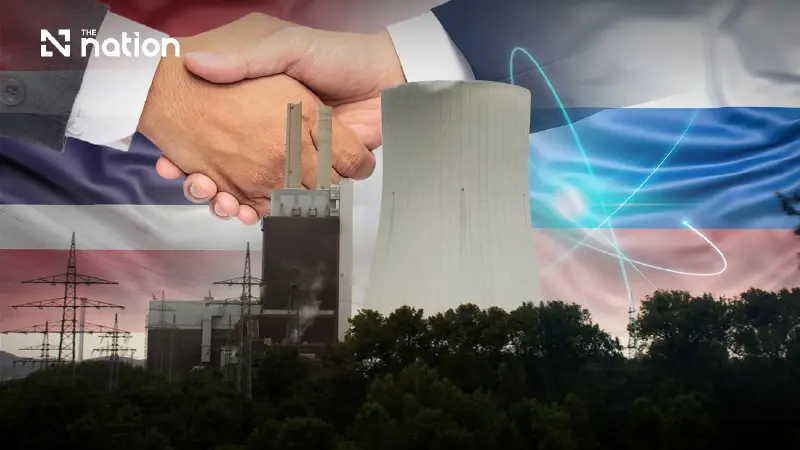


Ambassador Evgeny Tomikhin confirms Moscow's readiness to share small modular reactor technology, as bilateral trade rebounds and cultural ties expand
- Russia has formally proposed cooperation with Thailand on small modular reactors (SMRs), with its ambassador stating that Russia is the only country with currently operational SMR technology.
- The Russian ambassador described current bilateral trade, which reached $1.35 billion in the first seven months of the year, as being far below its potential, citing business estimates that it could reach $10 billion or more.
- The proposals for SMRs and increased trade are part of a broader effort to strengthen ties, underscored by a recent increase in high-level meetings between officials from both nations.
- Russia is promoting its SMRs, based on icebreaker engine technology, as a flexible energy solution for needs like large data centers or remote areas, with faster construction times than conventional plants.
Ambassador Evgeny Tomikhin confirms Moscow's readiness to share small modular reactor technology, as bilateral trade rebounds and cultural ties expand.
Russia has proposed bilateral cooperation with Thailand on small modular reactors (SMRs), Russian Ambassador Evgeny Tomikhin said on Wednesday (September 30). He added that Moscow wants to build on a run of high-level contacts to lift trade, which he described as far below its potential.
Speaking at a small media briefing in Bangkok, Tomikhin said Thailand and other countries had begun discussing nuclear energy options with several partners, Russia included.
He said Russia could offer a technological advantage in the short term.
"Only Russia today has working SMRs," he said, repeating what he said President Vladimir Putin told Prime Minister Anutin Charnvirakul at the Russia-ASEAN summit in Kazan in June.
He pointed out that Russia's reactors are based on engines built for icebreakers and that Russia has the only floating nuclear power plant, with two or three more on order.
Case for SMRs
Tomikhin said SMRs may suit some needs better than conventional plants, which take at least five to seven years to build. One or two SMRs, he suggested, could supply large data centres, and floating units could be moved to remote areas and relocated later.
Asked whether Russia could be the supplier, Tomikhin said, "Absolutely. We already proposed the option of bilateral cooperation."
He said the energy ministries of the two countries had shown "quite strong interest" in expanding cooperation beyond trade into technology.

"We always invite Thai friends to consider cooperation options with Russia," he said. Any decision, he added, rested with Bangkok. "It depends on your government's decision. I'm not convincing anyone. We just provide information."
He said the state nuclear corporation Rosatom is building plants in China and has agreements with Iran, India, Turkey, Egypt, Vietnam and Bangladesh. Indonesia, he said, is considering a similar project.
He described nuclear power as clean, safe and long-term, noting that nuclear plants generate almost 20% of Russia's electricity.
On public concern in Thailand, he said it was important for people to understand both the safety aspects and the risks of nuclear power. He argued that fast-growing economies want energy self-sufficiency.
He cited what he had been told about Thailand's heavy reliance on imported oil and gas from the Middle East and said Russia was offering information and options rather than lobbying.
Trade below potential
Tomikhin said bilateral trade reached US$1.35 billion in the first seven months of this year, more than 20% higher than a year earlier. Trade was slightly up last year.
"We see progress, we see development," he said, but the figure remained "definitely too far from the real abilities of both countries".
Reporters noted that a Thai deputy prime minister had suggested trade could exceed US$2 billion this year. Tomikhin declined to give his own forecast.

He said business council members had told a joint commission meeting in Moscow in August that trade could reach US$10 billion, or even US$30 billion in time, "if there will be no obstacles".
He pointed to Thailand's trade with China of close to US$100 billion last year and Russia's US$240 billion with China as evidence of what larger flows might look like.
Beyond energy and agriculture, he said, both sides could explore artificial intelligence, science, education, and medical and pharmaceutical products.
He said Thai fish, seafood, vegetables, fruit and ready-to-eat food could find buyers in Russia, while Russia could supply meat, dairy and other goods.
"Every deal should be fixed at some kind of appropriate price for two sides," he said.
He named two obstacles. The first is cross-border payments, which he described as an artificially created obstacle arising from Western sanctions.
He said new tools could ease it, including the digital rouble, and suggested central banks and ministries exchange experience. The second is the pace of large, state-owned corporations, which he said sometimes act more slowly than they could.
Run of high-level contacts
Tomikhin said contacts had intensified since Anutin's visit to Kazan. Thai ministers who have visited Moscow recently include Culture Minister Sabeeda Thaised and Deputy Prime Minister and Foreign Minister Sihasak Phuangketkeow, who attended the joint commission session.
More meetings are scheduled. A Russian delegation led by a deputy prime minister is expected in Bangkok for the annual meetings of the World Bank and the International Monetary Fund in mid-October, and he said he hoped the finance minister would also attend.
Thai cabinet members have been invited to a global digital forum in Moscow and a sports forum in Krasnoyarsk, both in October. At the end of October, Bangkok will host the second Russia-Thailand investment forum, after last year's event in Phuket.
Tomikhin said he had advised organisers to concentrate on three to five sectors, such as high technology including AI, energy, and agriculture and food security.
"Top priority, as I said many times, is bilateral relations, bilateral cooperation, trade," he said, adding that he wanted to see "more positive and favourable conditions" for trade and mutual visits.

Cultural programme
Tomikhin highlighted Sabeeda's recent visit to Russia, her first official trip to Moscow and St Petersburg, to attend the International Cultural Forum.
During the visit, she held discussions on the deployment and governance of artificial intelligence across creative industries, balancing technological adoption with the protection of traditional heritage.
He said Russia has introduced legal labelling for AI-generated content on official platforms. He described its Pushkin Card, which gives free access to cultural venues for people under 22, as an example of policy Thai counterparts might find useful.
Days of Moscow in Bangkok, marking the two capitals' sister-city ties, will run from 28 October to 1 November. The programme includes gala and ballet performances, a badminton match and an ice hockey master class.
The events form part of the Russian Seasons programme, which is organised in one country each year. It includes a St Petersburg puppet theatre production and the Eifman Ballet on 15 and 17 October, as part of the Bangkok Music and Dance Festival.
The Moiseyev folk dance company will perform at Prince Mahidol Hall on 3 and 4 November. A gala concert in late November will close the season. Tomikhin said next year's Russian Seasons are expected to be held in Vietnam.
Looking ahead, he said next year marks the 130th anniversary of diplomatic relations between Russia and Thailand. The occasion was discussed by the two countries' culture ministers in Moscow, and he expects a programme of cultural events, forums and exhibitions, and possibly political contacts, to mark it.
