
Inside Anutin’s handwritten appeal to Trump for tariff exemptions
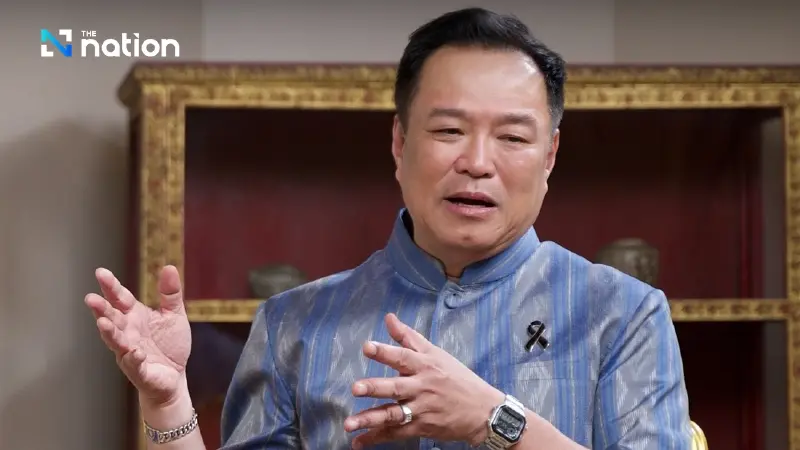


Washington has proposed tariffs of up to 18% on Thai goods, below the 19–20% Thai negotiators expected.
- Prime Minister Anutin Charnvirakul personally handed a handwritten note to US President Donald Trump during the APEC summit.
- The note requested that Trump consider tariff exemptions for specific Thai products, namely jasmine rice and maize.
- This action was taken in the context of proposed US tariffs of up to 18% on certain Thai goods under Section 301 of the US Trade Act.
- Anutin stated that Trump read the note and put it in his pocket, and that he also asked a US trade official to follow up on the request.
Prime Minister Anutin Charnvirakul said on 28 November that he had personally handed US President Donald Trump a handwritten note asking him to consider tariff exemptions for Thai jasmine rice and maize. Anutin said Trump opened the note, took his time reading it and slipped it into his suit pocket.
Speaking on his regular programme, Talk with PM Anutin, the prime minister said Deputy Prime Minister and Commerce Minister Suphajee Suthumpun had suggested writing to Trump during the Asia-Pacific Economic Cooperation summit in Shenzhen.
“I wrote ‘Dear Mr. President’ on a piece of paper in my own handwriting,” Anutin said. “I asked him to consider further tariff exemptions for important products such as jasmine rice and maize, and I handed it to him.”
Anutin said he had told Trump he could simply pass the note to the US trade representative. When the meeting ended, Anutin approached a US trade official seated behind him and asked him to follow up with the president.

What the proposed 18% tariff would mean
Anutin and Trump signed a joint statement in Manila on 17 November setting out the main terms of a reciprocal trade agreement. Anutin said lawyers were still drafting the full text and that US trade officials had acknowledged both sides’ efforts to reach agreement.
On 25 November, the Office of the United States Trade Representative proposed tariffs of up to 18% on covered Thai goods under Section 301 of the US Trade Act, taking existing Section 301 duties into account. The US notice also leaves open a rate of up to 25% if Washington finds the consultations and existing commitments unsatisfactory. Written comments are due by 5 January 2027, with public hearings scheduled to begin on 25 January.
Thai negotiators had expected a rate of 19–20%, Anutin said. Higher duties would make it harder for Thai exporters to compete in the US and for companies to plan production and investment.
Responding to criticism that his government had withheld details, Anutin said both countries had to agree to the terms. “It comes down to where each side is willing to compromise,” he said. “Team Thailand has done everything it can.”
Anutin sets 2027 goal for EU trade deal
Anutin said progress with Washington had encouraged interest from other countries and regional trading partners. On 24 November, the UK opened a public consultation to identify priorities for a possible free trade agreement with Thailand.
The prime minister cited the agreement Thailand signed with Peru on 19 November as an example of how long trade talks can take. Anutin put the negotiations at five or six years. At the signing, Peruvian President Keiko Fujimori described a process spanning 10 years. The two countries formally resumed talks in 2024.
Anutin said he hoped Thailand and the EU could conclude their free trade negotiations in 2027. A deal could benefit Thai-owned department stores, food and paper businesses, power plants and restaurants operating in Europe. Those businesses could buy more ingredients, components and packaging from Thailand, he said, adding that some imports currently face duties of around 20%.
OECD reviews can proceed in parallel
Anutin said Thailand had cleared its initial assessment by the Regulatory Policy Committee of the Organisation for Economic Co-operation and Development (OECD). He said 24 further stages remained and several could proceed at the same time.
According to Anutin, OECD Secretary-General Mathias Cormann welcomed Thailand’s cooperation and praised the civil servants who prepared the evidence for the reviews. Anutin said Thailand could act now to improve transparency and public scrutiny, remove discriminatory trade barriers and prevent forced labour while its membership bid proceeds.
