
Sultan Nazrin urges ASEAN to make healthy ageing accessible to all
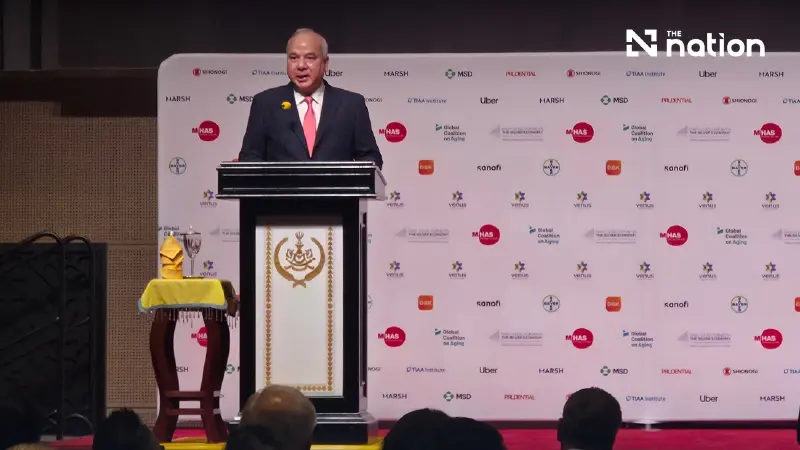


Sultan Nazrin Shah urges ASEAN to make healthy ageing affordable as populations age faster than economies grow, calling for integrated care and support systems.
- Sultan Nazrin Shah has urged ASEAN countries to make healthy ageing accessible to everyone, regardless of wealth, warning that many nations in the region are growing old before they become rich.
- He highlighted that Southeast Asia's population aged 60 and over is projected to more than double to 173.3 million by 2050, putting unprecedented pressure on public finances and family resources.
- The Sultan advocated for a proactive and integrated policy approach, connecting housing, healthcare, and finance to help people remain active and independent as they age.
- He reframed the "silver economy" not just as a consumer market but as an opportunity to create a more inclusive society that values the experience and contributions of older people.
His Royal Highness Sultan Nazrin Shah, Ruler of the State of Perak, Malaysia, has urged ASEAN countries to make healthy ageing accessible regardless of wealth, arguing that many nations in the region are growing old before they grow rich.
Speaking in the royal opening address, “The Silver Economy: A Foundation for Shared Prosperity”, at the Silver Economy Forum in Kuala Lumpur, Malaysia, on Wednesday (November 11), the Perak ruler called for societies to prepare for longer lives while protecting the dignity and independence of vulnerable older people.
“True inclusion requires concrete, practical application. Healthy ageing cannot become a commodity available only to those who can afford it.”
Rapid ageing tests ASEAN
The scale of ASEAN’s demographic transition is considerable. Citing an ASEAN Secretariat report, Sultan Nazrin noted that Southeast Asia’s population aged 60 and above was projected to rise from 77.4 million in 2020 to 173.3 million by 2050. That would increase the proportion of older people from about one in nine to one in five.
The same study estimated that demand for aged care in the region would more than double over the next two decades, adding pressure to public finances and family resources.
“Our regional demographic transition is moving at a pace far swifter than that historically experienced by the West. We face an unprecedented and sobering paradox: many ASEAN nations are growing old before they grow rich,” he observed.
Although this leaves governments less time to prepare, Sultan Nazrin argued that ASEAN also has an opportunity to design suitable systems from the outset. He contrasted this with developed economies spending heavily to adapt institutions built for younger populations, suggesting that the region could draw on its traditions of family solidarity and community responsibility.
ASEAN leaders had already recognised these issues in 2015, when they adopted the Kuala Lumpur Declaration on Ageing at the same convention centre. It called for cooperation between generations, preventive measures and accessible, age-friendly communities.
Sultan Nazrin maintained that the traditional sequence of education, employment and a short retirement had become outdated. Public policy should help people remain active and independent, while allowing support to increase gradually when their needs change.
“We can no longer treat housing, healthcare, financial security, and technology as separate areas of policy. They are interconnected corridors in the same lived environment,” he stressed.
He also urged earlier intervention, noting that the foundations of healthy ageing were laid decades before people turned 60. Planning should preserve people’s capabilities instead of responding only once frailty had developed.
Ageing as an economic and social opportunity
The transition brings economic opportunities alongside rising costs. Global research cited in his address estimated that consumers aged 60 and over accounted for more than 27% of global consumer spending, or about US$19 trillion, in 2026. Their share was projected to approach one-third by 2036.
However, Sultan Nazrin cautioned against measuring older people’s value solely through their spending power. He highlighted their accumulated experience, institutional memory and ability to mentor younger generations, arguing that age should never be equated automatically with dependency.
“The silver economy must be understood not merely as a marketing frontier for older consumers, but as a structural re-alignment of our economy towards inclusivity, innovation, and social stability.”
Drawing on former United Nations secretary-general Kofi Annan’s description of older people as our “future selves”, Sultan Nazrin argued that dignity and respect must extend to those who become severely frail and can no longer fully exercise their independence.
Malaysia's health and care challenge
Turning to Malaysia, Sultan Nazrin noted that about 12% of its population was aged 60 or above. Someone reaching 60 could expect to live for roughly another two decades, making later life a substantial period requiring appropriate planning and support.
Yet Malaysia’s National Health and Morbidity Survey 2025 found that just 14.7% of people aged 60 and above met its criteria for ageing well. The finding, Sultan Nazrin argued, exposed the distance between extending life expectancy and ensuring those additional years were lived well.
“We have become exceptionally proficient at adding years to our lifetimes. The question now is whether we can become equally proficient at ensuring those years are lived well,” he reflected.
He highlighted the economic case for better care, citing analysis referenced in Malaysia’s Care Strategic Framework which suggested that every ringgit invested in care could generate seven ringgit in wider economic benefits through growth, employment and income.
Malaysia’s Care Strategic Framework aims to position the country as a regional hub for long-term care. Its National Action Plan for Older Persons also recognises the importance of age-friendly environments and integrated support, although Sultan Nazrin argued that policy ambitions required coordination beyond individual ministries.
“But these frameworks cannot remain confined to the desks of a single ministry or sector. The opportunity we must seize is to connect these ambitions in practice,” he urged.
That would mean connecting healthcare planning with the design of homes and neighbourhoods, adapting financial systems to longer and more flexible working lives, and using technology to strengthen older people’s capabilities.
Sultan Nazrin closed by calling for a broader measure of progress: “Let us therefore judge our progress not merely by the years we add to a life, but by the life we are able to bring to those years.”
He concluded: “Longevity is one of humanity’s great achievements. Our task now is to build an architecture worthy of it.”
