
Govt vows to defend canal


Play
The government yesterday pledged tough measures to defend the highly vulnerable Waterworks Canal as concerns kept growing over the hygiene of tap water in Bangkok and its suburbs.
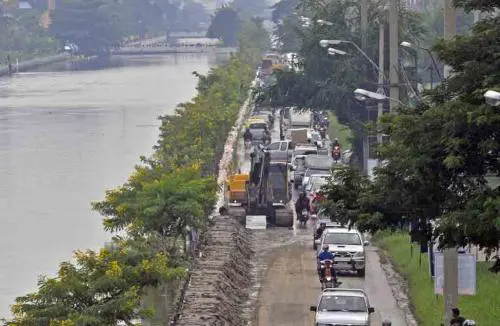
Police have been deployed along sensitive spots of the canal to protect them from possible destruction by angry flood victims. Laws will be stringently enforced to deal with those who pose threats to the canal, which is the key source of tap water to millions of people.
Repair works were completed at 17 barriers earlier demolished by angry flood victims, and a large number of sandbags were reinforced at those locations and others where the barriers were weakened by increasing pressure from rising floodwater. A location behind Wat Phai Kheo community where garbage storage areas are connected to a canal section required another night to complete.
Survival kits and relief supplies have been provided to local residents in the community after senior waterworks officials and senior police, including national police chief Pol General Priewpan Damapong and deputy MWA governor Wisit Wongwiwat, met with them. They later reached understanding with the angry flood victims. Medical services and two shuttle trucks were made available to them.
There was a confrontation on Wednesday night between a group of residents and officials working on repairs to a prapa canal section near Chaeng Wattana road, but the incident ended without problem.
Prime Minister Yingluck Shinawatra said legal action would be taken against barrier destroyers while pleading for understanding from flood victims. Asked whether special laws were required, she said provincial governors were authorised already under normal law to impose measures and enforcement of law against demolition.
Defence Minister Yuthasak Sasiprapha said deployment of soldiers at flood barriers was not needed, as local and Bangkokbased police were now supported by Border Patrol policemen.

He said immediate restructuring of the government’s Flood Relief Operations Centre was not needed and declined to comment further except on the military’s affairs and the ministry’s authority.
According to a police statement, a 1983 law imposes a threeyear prison term and/or a maximum Bt60,000 fine for any act that leads to damage to barriers, water or sluice gates which belong to any waterworks agency, or are part of the prapa canal or its connecting pipes, or any bridges over it.
Article 228 of the Criminal Code also subjects those who cause flooding, or health hazards to waterworks or production facilities, to a fiveyear prison term and/or a maximum Bt10,000 fine. A police commander said a number of people had been arrested under both laws.
The Metropolitan Waterworks Authority (MWA) has reduced daily production volume by 200,000 cubic metres (units) after the Dissolved Oxygen (DO) index had dropped as a result of contamination following leakage from demolished barriers, MWA governor Charoen Phassara said.
He said quality control of tap water production, which serves around 10 million people in Bangkok, had been constant and no heavy metal, Ecoli contamination or any germs causing digestive diseases had been found. But consumers should boil tap water before drinking for extra precaution.
Yingluck, speaking during an inspection trip with Charoen, pledged government support and funding for the MWA to build permanent concrete barriers along the entire prapa canal.
