
Big bags to stay, for now


Play
FROC says removing barrier won't help Don Muang residents
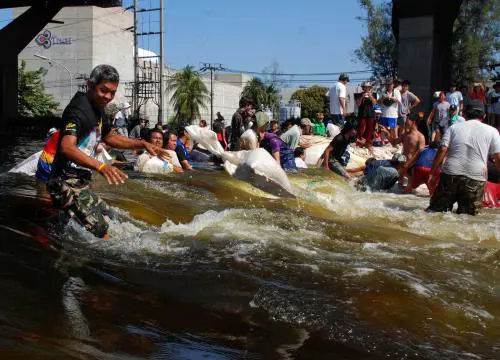
The Flood Relief Operation Centre (FROC) yesterday asked angry Don Muang residents to put up with the big-bag floodwall in their neighbourhood for seven more days.
“Removing a section of the structure or the whole structure now is not going to benefit people on ether side of the floodwall,” Anond Snidvong said yesterday. He sits on the FROC water-management panel.
The 15-km-long floodwall, a portion of which went up in Bangkok’s Don Muang district a week ago, has played a crucial role in preventing flood water from rushing into the capital’s inner zone. Flood-water levels are now clearly subsiding in many parts of Bangkok.
However, with the level of the flood water in the areas north of the floodwall about 70 centimetres higher than in areas below it, many Don Muang residents gathered to pressure the FROC to do something about the structure.
“We will not allow the dismantling of this floodwall. We are keeping a close watch on the structure,” FROC director Pol General Pracha Promnok said yesterday.
Anond said removing this crucial floodwall would not ease flooding in Don Muang district, as additional run-off water from the upper part of the country would simply enter the district and replace it.
“Please wait for seven more days. After that, we will be able to drain flood water out of their area via the Premprachakorn Canal. We have to wait till the water level in the canal gets low enough,” he said.
Pheu Thai MP Karun Hosakul, who represents Don Muang district, reportedly promised local residents that a section of the floodwall would be dismantled. Yesterday afternoon, many people were seen removing small sandbags on top of the big-bag structure.
A gap of six metres in the floodwall has been opened to allow the delivery of relief supplies to flood victims in areas north of the structure.
“But if you cause more gaps in the wall, Silom Road is at risk of submerging,” Anond said.
Deputy Bangkok Governor Thirachon Manomaipiboon said his team had told Prime Minister Yingluck Shinawatra in writing that the authorities must not bow to pressure from protesters and agree to remove the big-bag floodwall.
“The removal [of the wall] would hurt the country as a whole. The cost of economic and social damage and disruption to education may be to the tune of trillions of baht,” he said.
Thirachon urged that more information and extra remedial measures be provided to people affected by the floodwall. “For example, authorities must ensure that the flow of relief supplies is adequate and not interrupted,” he said.
Yingluck said FROC had already talked to Don Muang residents and promised to drain floodwater from their areas as soon as possible.
Meanwhile, many Nonthaburi residents vented their anger at the government, FROC and senior Nonthaburi officials on a Facebook page “Nam Kheun Hai Reeb Bok” (Issue Quick Alerts when Floodwater Rises). They discussed submitting a petition to the Nonthaburi governor, demanding an explanation of how the authorities will deal with the flooding, which has dragged on in their hometowns for over a month now.
Many believed the authorities’ attempt to re-open flooded Highway 340 will aggravate flooding in their areas.
Transport Minister ACM Sukam-pol Suwannathat acknowledged that some locals were unhappy. “Please understand that there’s not much water on the road surface,” he said.
Floodwater is being drained from Highway 340 as authorities need to prepare an alternative route for motorists heading to the country’s South should the main route, Rama II, become impassable.
At press time, Rama II Road remained open to traffic. Run-off water from the upper part of the country has approached the road but was apparently flowing into canals and low-lying nearby communities.
Bangkok Governor MR Sukhumbhand Paribatra yesterday ordered the evacuations of many communities in Bangkok’s seaside Bang Khun Thian district. “Flooding won’t last long in their communities. Run-off water will quickly flow into the sea,” he said.
According to Royal Irrigation Department chief Chalit Damrong-sak, the flooding situation in Bangkok’s western zone will significantly improve after November 16.
“By then, the water level in the Chao Phraya and Tha Chin rivers will be low enough for the water to be drained,” he said.
