
Panel urges reconciliation


Play
TRCT concerned about increased prosecution under the lese-majeste law; calls for more judicious approach
The Truth for Reconciliation Commission of Thailand (TRCT) has strongly recommended a different approach in dealing with criminal acts associated with the turbulent political conflict, which it said could be traced to the infamous share-concealment scandal of Thaksin Shinawatra.
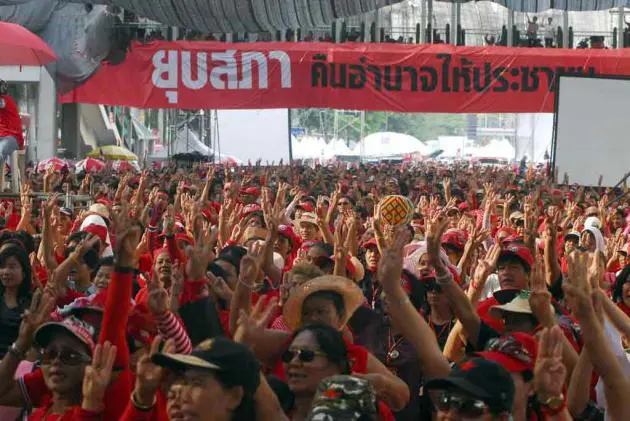
In its second report, the commission, set up by the Abhisit government, has emphasised the need to differentiate politically-driven criminal acts from common suspected crimes. And this principle should not be limited to only the red shirts, whose tumultuous campaign was plagued with allegations of violent activities and met with a drastic government crackdown in May last year, the commission said.
“TRCT sees the prosecution of criminal cases according to the Royal Decree on Public Administration in Emergency Situations BE 2548 (2005), the offence of unlawful assembly of ten or more persons under Section 215 of the Criminal Code, and other relevant cases relating to incidents of political violence before and after the 19 September 2006 coup, including cases of lese majeste under Section 112 of Penal Code and Computer Related Crime Act BE 2550 (2007) as all being related to the political conflict,” it said.
“TRCT believes that political conflict that has occurred in the past was a significant factor in later violence and violation of criminal law by various parties. The violence and violation of criminal law that occurred cannot be considered as normal social behaviour ... because the violation is fundamentally based upon political perspectives. Hence, even if such illegal behaviour affects and harms individuals and the public and requires that perpetrators be held legally accountable, criminal responsibility and criminal punishment may not conform to the punishment philosophy and may not render justice and contribute
to resolving the conflict.”
The commission led by Kanit na Nakhon made the following recommendations:
- Accusations and prosecution be clarified to see if they are consistent with the exceptional circumstances and if accusations are unduly harsh.
- Proceed in earnest with the temporary release of detainees.
- Keep in mind accused persons and defendants are not villains or criminals as in regular criminal cases but are accused of committing an offence in order to achieve political goals. If they can’t be granted temporary release, the government should arrange for their detention in an appropriate place.
- The principle of criminal justice which uses criminal prosecution measures and punishment is not appropriate for the current situation in our country. It is thus appropriate to study and apply the theories of transitional justice and restorative justice.
- Prosecutors should be requested to co-operate by delaying prosecution of these cases and by not taking them to court until collection of the relevant information is complete – correct and reliable.
- Rehabilitation of all parties affected by violent incidents is an important condition for bringing about reconciliation. An ad-hoc committee should be set up to supervise this process.
- The government, no matter how difficult it is, must be neutral.
- Remuneration should be paid to defendants after a final judgement is made by the court to dismiss the case.
The TRCT also expressed its concern regarding the prosecution of individuals for lese-majeste offences under Section 112 of Criminal Code and Computer Related Crime Act BE 2550 (2007). “The increase in the number of cases could have a political impact. TRCT believes that although the government has the obligation to vigorously protect the monarchy, regarded by Thai people with the utmost reverence, from being defamed by inappropriate behaviour and acts, the use of criminal prosecution without due regard for criminal policy or control guidelines for proper enforcement during times of political conflict can create national and international complications, particularly in regard to freedom of expression,” it said.
“The government should strictly and stringently proceed against those who defame and violate with malice against the monarchy. However, punishments should not be excessive or without direction or without regard to the sensitivity of the case as this might subsequently affect the monarchy domestically and internationally.”
The TRCT report ended with harsh criticism of the Constitution Court verdict in the “hidden assets” case. It dubbed the ruling “The root cause of violent events in Thailand” and deplored the fact that nothing had been done regarding the share-concealment issue.
FULL REPORT OF TRCT (English version starts from Page 20)
