
Korn warns against 'bank robbery'
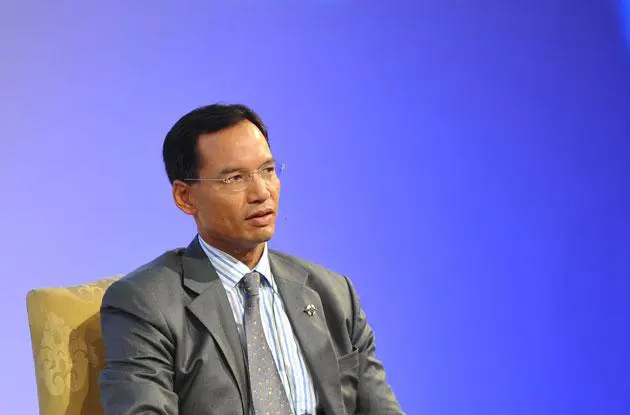


Former finance minister says using central bank assets to pay off debts is risky; opposes use of emergency decree
A government plan to issue emergency executive decrees authorising it to unilaterally use reserves to pay off public debts amounts to robbing the central bank, opponents of the scheme said yesterday. They urged lawmakers to drop what they call a risky move.
“The government ad-ministration is creating confusion and damaging public and investor confidence, as only a few ministers make key decisions without consulting other ministers first,” said former finance minister Korn Chatikavanij.
Korn pointed to several “vague” Cabinet resolutions, which had been approved only in principle and sent back to government agencies to consider more carefully.
Korn did not reveal any names, but his statement suggested Deputy Prime Minister and Commerce Minister Kittiratt Na-Ranong, often made key policy decisions without consulting Cabinet colleagues, in particular Finance Minister Thirachai Phuvanatnaranubala.
The two ministers are believed to have locked horns over the government’s latest move requiring the Bank of Thailand to pay off public debts of Bt1.14 trillion owed by the Financial Institutions Development Fund (FIDF). Observers say Kittiratt backs this extreme measure while Thirachai is trying to find a compromise with the central bank.
Kittiratt is expected to propose four emergency executive decrees to the Cabinet tomorrow, requiring the central bank – to pay off debts of Bt1.14 trillion; provide a soft loan of Bt300 billion; allow the government to borrow Bt350 billion; and set up an insurance pool worth Bt50 billion.
The government wants the central bank to pay off this large sum of public debt so it can borrow more to finance new investment projects in post-flood reconstruction.
“The third source of funding is the most risky which should be scrapped, otherwise the Cabinet would irresponsibly take everything from the central bank’s assets ” said Atavit Suwannapakdee, Democrat MP and member of the House Standing Committee on monetary affairs, finance, banking and financial institutions.
Korn said he did not see the necessity to issue emergency executive decrees for debt payment, but the government should propose the bills before Parliament instead of taking a shortcut.
Korn said government mistreatment of the central bank would lead to ballooning debt instead of public debt reduction as the government planned several populist projects – tax breaks for first-car buyers and free tablets for students.
“The government is going to rob the central bank… Countries that force central banks to print money were labelled as banana republics,” said Korn, referring to the poor sovereign credit ratings of countries failing to hold fiscal and monetary discipline.
Korn said he agreed with points like the government seeking help from the central bank and making use of its profits to pay the debts of the FIDF. But Korn said he did not agree with attempts to acquire central bank reserves for debt payment.
“Part of international reserves should be invested in overseas assets and the central bank should make its own decision on such investment,” said Korn.
He was responding to the proposal of Virabongsa Ramangkura, chairman of the strategic formulation committee for reconstruction and future development, who said that US$130 billion held as part of the total international reserves of $180 billion, should be utilised for flood-prevention investment. Korn said he did not object if financial institutions were asked to pay more fees to the central bank as they benefited from the market stability that followed the Asian financial crisis of 1997.
“But the government must make sure banks do not pass on the cost to 67 million depositors,” Korn said.
Opposition leader Abhisit Vejjajiva said an executive decree to borrow Bt350 billion might breach the Constitution because there was no reason for issuing an emergency decree. He said that it was not an emergency matter to borrow Bt350 billion, since such big investment projects take 3-7 years to implement.
Nor does Abhisit agree with government asking the central bank to provide soft loans of Bt300 billion. He said the government could assign the Government Savings Bank to do that job. “The government chose to ask the central bank because it wanted to shift the interest rate burden incurred from soft loans to the central bank,” said Abhisit.
“In the past the governments never forced the central bank to print as much as Bt300 billion for injection into the economy. We’ll closely watch how the new amount of money impacts on inflation,” he added.
Hunt for funds
Sources of funds the government eyes for debt payment
1 Profits generated from the central bank’s activities
2 Assets generated by the annual yields account of the central bank
3 Cash and other asset classes of the central bank, demanded by Cabinet
4 Fees or surcharges collected from financial institutions by the central bank
