
Govt urges state health office to lift game in second decade
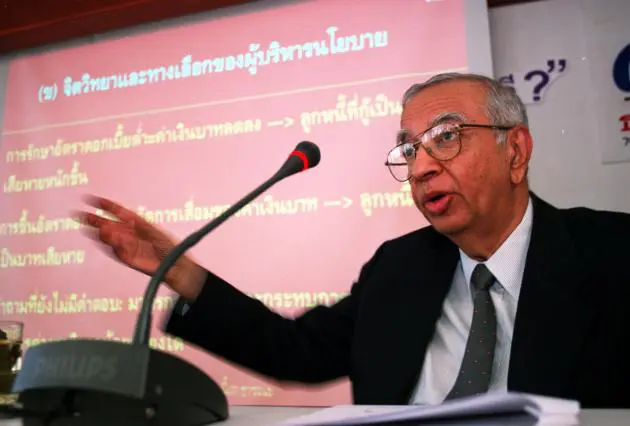


The National Health Security Office (NHSO) needs to provide better-quality medical services and financial management to improve its coverage over the next 10 years.
“It’s time for the NHSO to focus on improving its healthcare coverage for eligible people,” prominent economist Ammar Siamwala said.
Speaking in a video presentation to the National Academic Conference entitled “Universal healthcare coverage for the second decade”, Ammar said that when universal healthcare coverage – known as the 30-baht health-care scheme – was established in 2002 by former prime minister Thaksin Shinawatra’s government, only about 48 people had access to medical treatment at the hospital.
Today, after 10 years, Ammar said most healthcare service receivers were satisfied with NHSO’s universal healthcare coverage as it gave them access to the services.
But for the next 10 years, he said NHSO should improve the quality of medical services provided.
“We want doctors to sit with us and talk with us, not only for two minutes. If NHSO can follow suggestions like this, the problems of patients will be resolved,” he said.
Meanwhile, Public Health Minister Witthaya Buranasiri said the government would pressure for better-quality healthcare services for patients.
It will adjust the benefits of national healthcare schemes, including the universal care scheme, to keep to the same standards.
Dr Sutham Pinchareon of University Hospital Network said universal healthcare coverage has helped people to access medical services, but it has also created trouble for some medical workers.
State hospitals with medical schools have had to shoulder the financial burden of providing medical services for universal healthcare scheme members.
During the past 10 years, NHSO has had a limited budget for medical treatment, medical devices, and pharmaceutical products.
“We have had to use generic drugs for patients instead of trade name drugs,” he said.
Moreover, state hospitals have not increased monthly salaries or special allowances for medical workers due to lack of budget.
“That’s why we welcome patients registered with the Civil Servant Medical Benefit scheme as we can reimburse the budget fully,” he said.
To reduce financial tension among hospitals, Sutham said some had opened private divisions and special clinics to raise money for the hospital management.
Dr Samrit Srithamrongsawat, director of the Health Insurance System Research Office, said a study evaluating the NHSO during the past 10 years had found its universal healthcare scheme had helped the poor to reduce their healthcare financial burden.
The study also suggested that NHSO and other agencies should reduce the inequality in healthcare services of the three national healthcare schemes. They also should resolve the problem of human resources.
Another study by Dr Oraphan Methadilok of the Public Health Ministry’s Medical Service Department found the mortality rate among children aged between 28 days and one year had risen from 1.9 per 100,000 population in 1996 to 4.3 per 100,000 in 2010.
“We don’t know the cause of these deaths and we need an investigation,” Oraphan said. “We invest a lot of money to improve healthcare services but the figures show that the rate of death among children has drastically increased,” she added.
