
Yingluck gets by with a little help


Play
Prime minister charms invitees and takes critics in her stride as she handles foreign correspondents in English
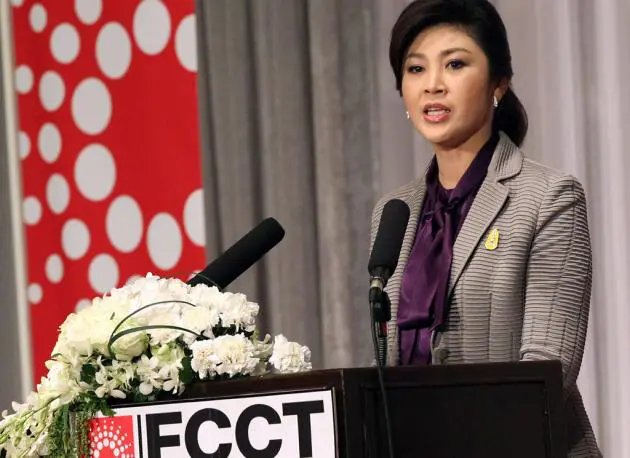
Some members of the Foreign Correspondents’ Club of Thailand (FCCT) didn’t expect much from Prime Minister Yingluck Shinawatra, who gave a keynote speech and answered questions at an annual dinner event on Friday night.
One Western correspondent said as hundreds sat down for dinner he expected many long moments of awkward silence as the PM struggled with her English and mispronunciation. The PM is known for her infamous gaffe when she welcomed US Secretary of State Hillary Clinton, saying “overcome” instead of “welcome” and the more recent controversy surrounding her Thai-language address to Japanese investors in Tokyo – without a simultaneous interpreter or translated text.
“It’s a pity because she looks very beautiful tonight,” said the same journalist, who sat at one of the VIP tables at the Intercontinental Hotel. Yingluck looked charming yet business-like in a light grey jacket and skirt with a hint of stronger colour from a purple shirt.
FCCT President Nirmal Ghosh assured me on the phone just prior to the dinner that the PM would deliver her speech in English but said some ministers accompanying her may answer questions on her behalf.
Not long after Yingluck began her speech, mostly read from a script, she warmed the crowd by urging them to please be kind to her, adding the Thai phrase “na ka” or “please”, which succeeded in drawing a round of applause.
Through the course of the question and answer session, she occasionally sought assistance for words and sentences that she didn’t quite hear or understand, however.
Some, like a prominent Western Ambassador who sat next to me at a VIP table, appeared to have been won over by Yingluck’s charm and pleasant look despite the premier’s delicate English.
“Her English is very good. Her English is not bad at all,” the Ambassador, who asked not to be named, quipped. When Yingluck ran into trouble, not understanding one question blurred by an Irish accent, the same diplomat interjected: “Irish accent! I don’t understand either.”
Yingluck survived the grilling in English with some witty remarks, coy demeanour and pleasant smiles, however.
Shawn Crispin, a former Far Eastern Economic Review correspondent now with yellow-shirt-leader Sondhi Limthongkul’s Asia Times Online, asked Yingluck if she and her older brother, the ousted fugitive former premier Thaksin, were playing a double game, in which Yingluck presents a smiling face to the public while Thaksin works behind the scenes to undermine his rivals and the judiciary in an effort to gain an amnesty.
“Sorry I don’t understand the double game [allegation] because I never play games,” Yingluck replied, winning applause.
When I asked Yingluck what she could say to change the minds of millions of Thais who continue to believe that this government is in fact run by Thaksin and not Yingluck, she replied: “Time will prove me.”
On why foreign businesspeople should continue investing in Thailand when the minimum daily wage will soon be increased to Bt300, the premier said the move was sought to help workers survive as no major wage hike had taken place over the past decade. She said she would see to it that more infrastructure is built and was confident that Thailand is strategically placed for trade and investment.
At least half a dozen times an aide and the FCCT’s Ghosh had to help the prime minister with questions in English that she didn’t fully grasp. I helped her once with a shout from my table, which was not far away from the stage, with a Thai translation of the word “prosecution”.
There was plenty of delicious English from the PM, such as when she referred to the need to make greater Internet connectivity available in order “to get the broader mind, to get the deeper information”.
Nick Nostitz, a German photographer and red-shirt sympathiser, wasn’t fussed. He felt people who obsessed about Yingluck’s level of English were like “fascists”.
Midway through the question and answer session, Yingluck employed more wit and appeared to have pulled it off. Even Crispin, an ardent critic of Thaksin, acknowledged privately at the end that her answer made him look like a bad guy trying to pin her down.
Some continued to comment about Yingluck’s English, however. One expat suspected that Yingluck might in fact understand English better than we think she does – and just pretends not to understand in order to deflect questions that she has no wish to answer.
When it was all over, Yingluck thanked the FCCT in English: “Thank you for help me to translate.”
And as I made my way out of the Grand Ballroom I ran into Pheu Thai MP Jarupan Kuldiloke and told her that perhaps the premier would benefit from some English-language practice.
But Jaruphan said the prime minister wasn’t taking any tutorials as she was very tired at the end of every working day.
