
"Triumph of the people" : Aung San Suu Kyi


Play
Yangon - Myanmar democracy campaigner Aung San Suu Kyi on Monday called her party's landslide victory in weekend by-elections a "triumph of the people" and said she hoped they represented a new dawn.
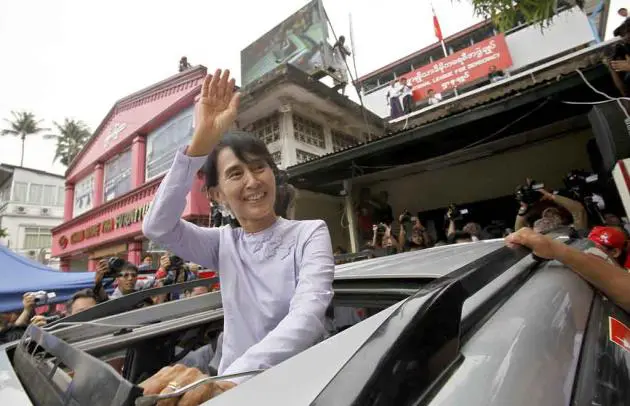
"We hope this will be the beginning of a new era of involvement by the people in the politics of this country," Suu Kyi told a crowd of well-wishers who had gathered outside the Yangon headquarters of her party, the National League for Democracy (NLD).
The NLD said that according to the vote counts so far, it had won 43 of the 45 seats contested in Sunday's by-elections in formerly military-run Myanmar.
The party ran candidates in 44 races, and it was likely it would win all 44 once the final tallies were made, NLD deputy leader Kyi Toe said.
"It is not so much our triumph as a triumph of the people who have decided that they have to be involved in the political process in this country," Suu Kyi said. The crowd greeting Suu Kyi chanted, "Mother Suu! Mother Suu," and, "Good health! Good health!"
Suu Kyi, 66, had suffered bouts of exhaustion on the campaign trail. The Nobel Peace Prize winner, who had been detained for 15 years by the former ruling military junta, won an estimated 90 per cent of the votes cast in her Kawhmu constituency, 30 kilometres south of Yangon, according to the NLD.
The result would assure her a seat in the lower house of parliament, where she is likely to become opposition leader.
Official results were expected in a few days, but the NLD released the party's results from its Yangon headquarters as the vote counting was taking place publicly and in the presence of the participating parties.
The government's Union Solidarity and Development Party, the NLD's chief rival in the by-election, had not won a single seat as of Monday.
The party headquarters issued no statement on the whopping defeat even in four constituencies in Naypyitaw, the capital and traditional stronghold of the government and military.
It was the first election Suu Kyi contested. She was under house arrest during Myanmar's past two general elections in 1990 and 2010. In the 1990 vote, the NLD won by a landslide but was denied power for two decades by the junta.
"I think the government this time didn't have much incentive to rig the vote, unlike the previous junta," Win Min, a political scientist at Harvard University, said, pointing out that the by-elections' 45 seats account for a fraction of the combined 1,160 seats in the three houses of parliament.
"They wanted to see the by-election go fairly free and fair so that the international community would respond to it positively, especially by easing the main parts of the financial sanctions, which the EU and US are now likely to do after the by-election went fairly well," he said.
The NLD reported irregularities during the campaign - such as deceased people appearing on voter lists, wax placed over NLD boxes on ballots to make checking them impossible and verbal attacks on NLD candidates - but no significant violence was seen.
Suu Kyi said the NLD would submit a full report on the irregularities to the Union Election Commission "not out of vengeance but for the sake of future elections." The by-elections were held to fill seats left empty after some legislators took up cabinet posts a year ago.
Despite the low number of seats up for grabs, the by-elections were seen as a litmus test for the next general elections, to be held in 2015, and for the status of Myanmar's political reforms as the international community considers easing the sanctions placed on the junta.
The NLD did not contest the 2010 general elections, which were won by the pro-military Union Solidarity and Development Party. They were widely criticised as being neither free nor fair.
However, the government they put in power, led by former general and President Thein Sein, has steered a reform course for Myanmar, which had been governed by military dictatorships from 1962 to 2010. They made Myanmar an international pariah because of their poor human rights records.
Thein Sein opened a dialogue with Suu Kyi in August, paving the way for her and the NLD to join mainstream politics.
The NLD said that according to the vote counts so far, it had won 43 of the 45 seats contested in Sunday's by-elections in formerly military-run Myanmar.
The party ran candidates in 44 races, and it was likely it would win all 44 once the final tallies were made, NLD deputy leader Kyi Toe said.
"It is not so much our triumph as a triumph of the people who have decided that they have to be involved in the political process in this country," Suu Kyi said. The crowd greeting Suu Kyi chanted, "Mother Suu! Mother Suu," and, "Good health! Good health!"
Suu Kyi, 66, had suffered bouts of exhaustion on the campaign trail. The Nobel Peace Prize winner, who had been detained for 15 years by the former ruling military junta, won an estimated 90 per cent of the votes cast in her Kawhmu constituency, 30 kilometres south of Yangon, according to the NLD.
The result would assure her a seat in the lower house of parliament, where she is likely to become opposition leader.
Official results were expected in a few days, but the NLD released the party's results from its Yangon headquarters as the vote counting was taking place publicly and in the presence of the participating parties.
The government's Union Solidarity and Development Party, the NLD's chief rival in the by-election, had not won a single seat as of Monday.
The party headquarters issued no statement on the whopping defeat even in four constituencies in Naypyitaw, the capital and traditional stronghold of the government and military.
It was the first election Suu Kyi contested. She was under house arrest during Myanmar's past two general elections in 1990 and 2010. In the 1990 vote, the NLD won by a landslide but was denied power for two decades by the junta.
"I think the government this time didn't have much incentive to rig the vote, unlike the previous junta," Win Min, a political scientist at Harvard University, said, pointing out that the by-elections' 45 seats account for a fraction of the combined 1,160 seats in the three houses of parliament.
"They wanted to see the by-election go fairly free and fair so that the international community would respond to it positively, especially by easing the main parts of the financial sanctions, which the EU and US are now likely to do after the by-election went fairly well," he said.
The NLD reported irregularities during the campaign - such as deceased people appearing on voter lists, wax placed over NLD boxes on ballots to make checking them impossible and verbal attacks on NLD candidates - but no significant violence was seen.
Suu Kyi said the NLD would submit a full report on the irregularities to the Union Election Commission "not out of vengeance but for the sake of future elections." The by-elections were held to fill seats left empty after some legislators took up cabinet posts a year ago.
Despite the low number of seats up for grabs, the by-elections were seen as a litmus test for the next general elections, to be held in 2015, and for the status of Myanmar's political reforms as the international community considers easing the sanctions placed on the junta.
The NLD did not contest the 2010 general elections, which were won by the pro-military Union Solidarity and Development Party. They were widely criticised as being neither free nor fair.
However, the government they put in power, led by former general and President Thein Sein, has steered a reform course for Myanmar, which had been governed by military dictatorships from 1962 to 2010. They made Myanmar an international pariah because of their poor human rights records.
Thein Sein opened a dialogue with Suu Kyi in August, paving the way for her and the NLD to join mainstream politics.
