
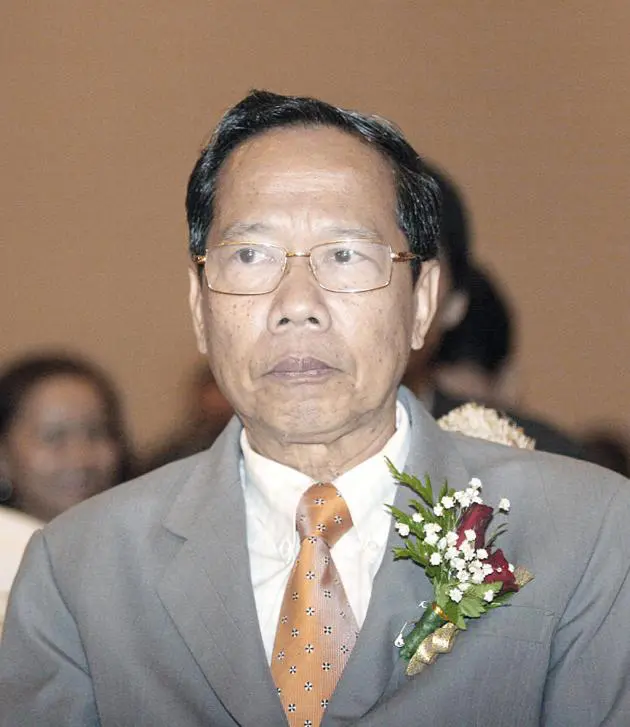
Top judge has led a life full of achievements


Play
Many comments by Constitution Court president Wasant Soypisut have been quoted by the media - and become the talk of the town when he was criticised - after the top judge ordered Parliament to suspend the final reading of the government's charter amendme
“If the Parliament does not follow the order of the Constitution Court, it is for [Parliament] to be responsible itself. However, the court has considered this and has the power to examine [the draft] according to the law,” he said.
“On issues of turning the sky and the land upside down, changing the political system, should we wait for the Attorney-General only?”
When asked if the Constitution Court was acting as a tool of the “ammart” (aristocrats), Wasant said the real head of the ammart was the prime minister, as she was the most powerful person in Thailand.
He also borrowed a line from a television commercial to tell the media he could be tolerant of criticism. The legal drama has put the spotlight on the top judge.
Wasant, now 65, was very good student in his younger days. After finishing at Suan Kularb Wittayalai School, he studied at Thammasat University’s Faculty of Law.
He was a good poet in his second year there and acquainted with SeaWrite winner Naowarat Pongpaiboon, who was his senior.
At the age of 20 he graduated with an honours degree. One of his classmates was Klanarong Chantik, now a member of the National Anti-Corruption Commission.
Wasant became a trained lawyer at the firm of MR Seni Pramoj, the former premier and Democrat Party leader. Seni gave lawyers in his firm membership applications to promote the party but Wasant did not sign it, saying he had no intention to work in politics.
He passed the Thai Bar examination before turning 21. A classmate at this time was Apichart Sukhagganond, the current Election Commission chairman.
Wasant went on studying and passed the test to be a court judge. He took many important positions and roles. He was head of the Supreme Court’s Juvenile and Family division, the Supreme Court’s Labour division, then head of Appeal Court judges in Region 7.
During the “Judicial Crisis” in 1991-1992, Wasant was spokesman for the “Judicial Rebel”, speaking via loudspeakers in front of judges protesting against the then justice minister Prapas Uaychai, who interfered with the appointment of judges and reshuffled them.
He was a judge’s assistant at that time. But those actions ended with him being transferred. More recently, Wasant was one of the judges who convicted Thaksin Shinawatra in the Ratchadapisek land case, which saw the former PM given a two-year jail term.
He was also a judge on the case involving members of the anti-corruption commission, who gave themselves a pay hike. The Supreme Court’s division for political office-holders sentenced the NACC members to two-year suspended jail terms.
Wasant voiced his opinion at a Supreme Court judges’ general meeting that the ballot booth should make the marking of voters’ ballots secret and others should not be allow anyone to see how people vote. His idea led partly to nullification of the April 2, 2006 election.
Wasant was also a defendant’s witness when Prasong Soonsiri was sued by a majority of Constitution Court judges for criticising the ruling that found Thaksin not guilty of concealing his ownership of shares in 2001.
In 2006, Wasant’s name became widely known after the Election Commission led by Police General Wasana Permlarp was mired in scandal. During the EC member selection, Wasant gave harsh opinions in a Senate meeting. He was not selected for the EC post.
But Wasant was selected to be a Constitution Court judge on May 28, 2008. On August 24 last year, he was voted unanimously to succeed former Court president Chut Chonlavorn, who resigned earlier.
