
Call for overhaul of science, maths


Obec backs proposal at national conference to adjust teaching, tests
Thailand has suffered a decline in academic results locally and internationally for many years because of uneven science and maths education provided to students over decades.It is time to start an overhaul to lift the quality of Thai science and maths education, a national conference was told yesterday.
“We will have to seriously adjust teachers’ teaching, national tests, student assessments and teachers’ promotions,” the Office of Basic Education Commission (Obec) deputy secretarygeneral Benjalug Namfa told a press conference yesterday.
“All these changes will come after scientific process, standards and indicators of science and maths are improved to be clearer and correlating to students’ learning performance,” she said.
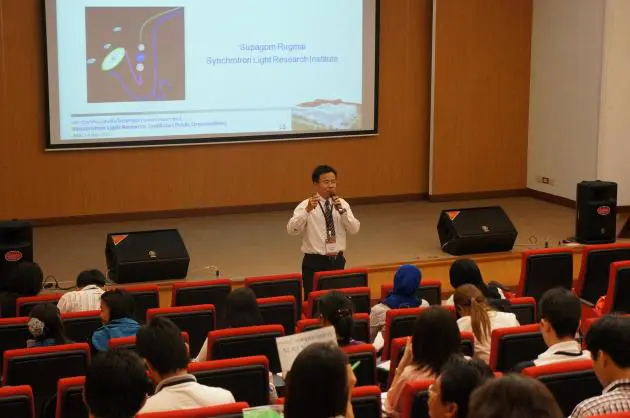
She spoke at a conference under the theme “Upgrading the Quality of Science Education: Basic Education 2012 in Bangkok”.
The twoday symposium was attended by educational specialists from Obec, the Kenan Institute Asia, MSD INSTEP (Inquirybased Science and Technology Education Programme), the Science Institute and representatives from teacher groups nationwide.
Education experts from agencies in the US and South Korea also gave recommendations to try to help Thailand lift its education quality.
“Our old style of teaching, which limits students’ learning mostly to classrooms, will have to be changed immediately,” Professor Emeritus Dr Montri Chulavatnatol, chairman of the board of the Institute for the Promotion of Teaching Science and Technology (IPST), said.
“Updated knowledge and skills are outside the classrooms, such as in industries and open sources on the Internet. Having our students learn mainly in classes where educational resources are inadequate, we won’t be able to succeed or go further. We must have them learn beyond classrooms.”
Benjalug said Obec was helping teachers identify which outside classroom activities are best for lifting learning standards.
They were preparing to launch a national campaign that would motivate teachers to have pupils learn from practical activities rather than memorising content.
“Singapore has a ‘teach less, learn more’ campaign,” she noted.
Montri said it was not just the style of teaching that needed to be changed. The current student assessments were based on knowledge or content, which was not enough to prepare students for the real world. Experts urged them to change the assessments, so they assess not only students’ knowledge but also their thinking ability and problem solving.
Benjalug said national tests like the Ordinary National Educational Test (ONet) would be adjusted from their contentbasis. They would have to really reflect students’ learning in the process of scientific thinking.
“We will start with adjusting the standards and indicators according to the learning goals. So, they will clearly state what students need to learn and what skills they need to have. The knowledge and skills they acquire should be useful for them in real life,” she said. “Students’ performance will be counted as part of consideration of teachers’ promotions.”
Recommendations would be put to the Education Ministry to drive the changes, she said.
In 2011, Thailand ranked 51st out of 57 countries worldwide in a competitive education proficiency assessment by the International Institute for Management Development, compared to 46th place in the 2007 rating.
The Programme for International Student Assessment has pointed out the deficiency in analysis and learning development of Thailand, where the average grade in 2009 stood at 49th among 65 countries.
