
Govt plans to go ahead with dam as Sukhothai inundated


Kaeng Sue Ten Dam should hold up to 1,200 million cubic metres of water
The government is likely to go ahead with plans to construct the Kaeng Sue Ten Dam in Phrae to prevent flooding in Sukhothai and lower northern regions.
Natural Resources and Environ-ment Minister Preecha Rengsom-boonsuk said yesterday that he would ask Prime Minister Yingluck Shinawatra to consider building a dam in Tambon Sa-Iab to hold back the Yom River and reduce flooding in Sukhothai. This was after he spoke to locals affected by flooding in the province.
Preecha said the ministry had studied two projects – building the Kaeng Sue Ten Dam and other permanent reservoirs in the upper and lower parts of the Yom River.
“The government will make the plan to build Kaeng Sue Ten Dam urgent,” he said, after reporting on the flooding in Sukhothai in a phone call to Yingluck.
The Kaeng Sue Ten Dam is expected to hold 1,200 million cubic metres of water, and the two reservoirs in the upper and lower Yom River 700 million cubic metres of water.
Water Resources Department director-general Jatuporn Burutphat said the ministry would ask the government to allocate Bt5 billion to improve the capacity of 364 water-retention areas, or monkey cheeks, in the region. These monkey cheeks are able to hold 1.4 billion cubic metres of water.
Hannarong Yaowalert, president of the Foundation for Integrated Water Management, said the Kaeng Sue Ten Dam would not protect Sukhothai from floods, adding that the government should build other dams at the Srisatchanalai district and Phrae province’s Wang Chin district which are 100 kilometres from Tambon Sa-Iab. He said heavy precipitation from these areas flows into the Yom River.
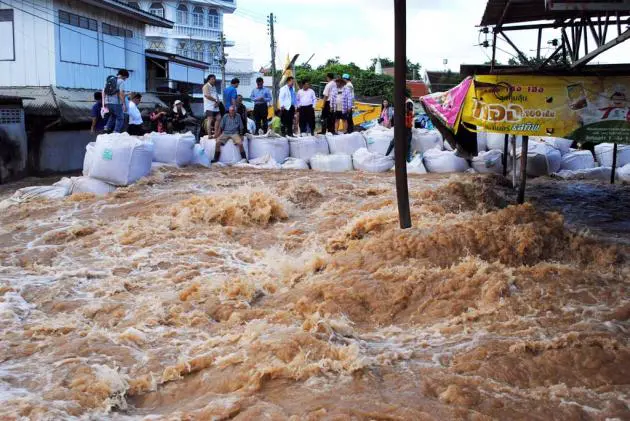
Flooding in the Sukhothai municipality area was caused by breaks, some about 13 metres wide, in the flood barriers behind the Wat Ratchatanee community.
Floodwaters destroyed parts of the concrete wall and leaked under the barriers, before flowing into community areas, Jatuporn said. The Wat Ratchatanee community area was under more than 1.5 metres of water. About 5,000 cubic metres of floodwater inundated 5 square kilometres, affecting more than 2,500 households in six communities since last Sunday evening.
Previously, local authorities used hundreds of big sandbags to block the water but to no avail.
In order to help the flood-affected areas in Sukhothai municipality, Preecha said he had told the provincial governor and other officials to install more than 1,000 gabion baskets, or heavy wire netting containing rocks, to block water from leaking through the barriers at Wat Ratchathanee community.
He also ordered local authorities to deploy 20 pumps to drain the water back into the Yom River. “We expect the floods to recede within three days,” Preecha said.
The minister also assigned the provincial governor to take over the command centre and instructed officials to destroy roads in order to drain water out of the municipality.
Science Minister Plodprasob Surassawadee, who is also chairperson of the flood management committee, yesterday apologised to flood-hit Sukhothai residents, saying he was unaware of the cracks in the cement barriers that were built in 2001, which allowed the water to flow into town. He said the flooding in Sukhothai’s municipal area should recede in a couple of days.
Meanwhile, Sukhothai Provincial Administration Organisation chief Pannasiri Kulanartsiri said the province was still at risk because the level of water in Sawankhalok district was rising by up to a metre and would flow into the provincial capital.
She also warned that the riverbank at more than 100 spots along the Yom River in Sukhothai province were close to collapsing.
Theerapong Chaythaweesuk, 50, the owner of an electrical goods store, said his shop was under a metre of water. He said all his stock was damaged because he did not have time to move it to higher ground. “Nobody warned us about flooding. The floodwaters rose very fast,” he said.
Somjai Yensabai, a senior official from the Mineral Resources Department, yesterday warned riverside provinces to watch out for the risk of high pressure
“This pressure will be really high when water levels in the river and neighbouring areas [had risen] by more than a metre,” he said, adding that it would pose a serious risk in areas with sandy soil.
Somjai warned that since Angthong, Lop Buri and Sing Buri all have sandy soil, they were at greater risk. He also pointed out that dredging along waterways on high ground could have adverse impacts too because water could rush down faster than usual to provinces in adjacent low-lying zones – such as Sukhothai, Phitsanulok, Phichit, Angthong and Ayutthaya.
“We noticed that if it does not rain, soil on high ground dries very fast,” he said, adding that tropical storm Sanba would be close to Thailand in 10 days and would bring heavy downpours to many provinces in the North and Northeast.
