
Poor results at half all primary schools
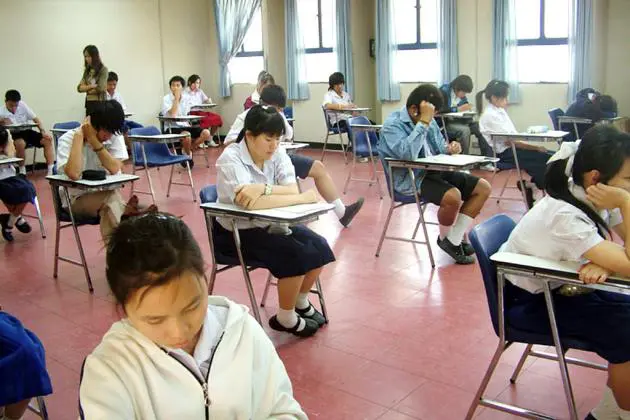


Well over half of the 28,000 schools nationwide failed to achieve the average score in every subject of the O-Net (Ordinary National Educational Test) for Prathom 6 (Grade 6), according the Office of the Basic Education Commission (Obec).
Students at 28,290 schools took the test. Scores at 16,294 schools were lower than the overall average of 49.36, while the remaining 11,995 schools reached average or higher-than-average scores, Obec secretary general Chinnapat Bhumirat said yesterday.
More than half of the schools – 18,681 – failed to pass the average English test score of 38.37. Only 9,609 schools posted higher-than-average scores for English.
For maths, 15,448 schools failed to reach the average score of 52.40. The science test average was 40.82, but 17,076 schools failed to achieve it. Average scores for Thai language were 50.04, and 16,290 schools fell below that mark, Chinnapat said.
For social science, 16,432 schools fell below the average of 52.22. In health and physical education, 14,780 schools scored lower than the 58.87 average. In art, 16,169 schools dropped below the 46.75 average, while technology saw 15,478 schools register a score below the 55.38 average, he said.
Chinnapat said an analysis of the scores gave useful information for budget management and teacher development. It would enable Obec to tailor its budgets to suit each school and educational area office. The 10 offices with the lowest O-Net scores will have to create plans to improve student performance, while those with the highest scores, including top-scoring Kalasin Primary Educational Service Area Office 1, will reveal how they improved students’ results.
At an end-of-month meeting Obec will propose changes to criteria for judging teachers. Teachers at schools with average O-Net scores higher than 70 percentile will be judged on their students’ performance and no longer be required to present extensive evidence of classroom work. Obec will have them train other teachers, Chinnapat said.
