
Suu Kyi supports easing US sanctions


Play
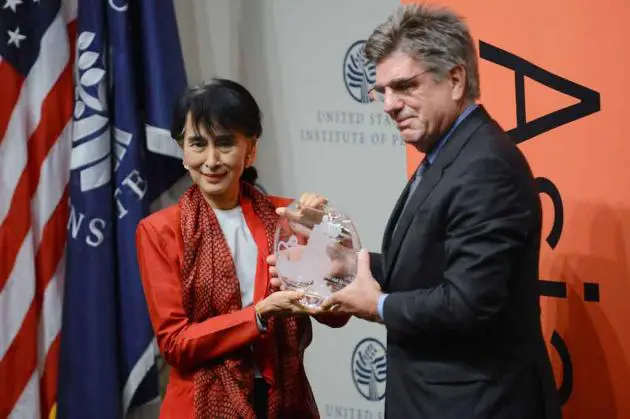
Washington - Myanmar's Nobel peace laureate Aung San Suu Kyi said Tuesday that she would support further easing of US sanctions onher country as she made her first visit to the United States since being freed from house arrest in 2010.
"I do support the easing of sanctions because I think that ourpeople must start taking responsibility for their own destiny," she said at the US Institute of Peace in Washington.
"I do not think we should depend on US sanctions to keep up the momentum of our movement for democracy; we've got to work at it ourselves." Secretary of State Hillary Rodham Clinton met with Suu Kyi earlier Tuesday at the State Department, as the democracy activist and newlyelected parliament member begins a more than two-week visit to theUnited States, where she will is to pick up several awards inrecognition of her long struggle for democracy in the former junta-ruled pariah state.
"It's wonderful to see Suu Kyi back in Washington as a free andforceful leader of a country opening up to the world in ways that would have been difficult to imagine even recently," Clinton said inintroducing Suu Kyi at the US Institute of Peace.
"Those flickers ofprogress ... have been growing and strengthening." The US resumed diplomatic relations last year with Myanmar, easingsome sanctions on the country and sending its first ambassador in decades.
Suu Kyi, 67, on her third trip abroad since she was freed from house arrest almost two years ago, is on her first visit to the US since the early 1970s. She is head of the National League for Democracy, the opposition party that fought for democratic change inthe impoverished south-east Asian nation.
Suu Kyi, who spent 15 years under house detention between 1989 and2010, will receive the Congressional Gold Medal in a ceremony Wednesday in the Capitol Building.
Suu Kyi won the Nobel Peace Prize in 1991 for her struggle tobring democracy to Myanmar, also called Burma, which was under military rule from 1962-2010 and is now under a pro-military, nominally elected government.
Suu Kyi was released from a seven-year stint under house arrest onNovember 13, 2010, but her real political freedom began in August 2011, when Myanmar President Thein Sein opened a dialogue with the former arch opponent of the junta, which had ruled Myanmar from 1988-2010.
After meeting with Thein Sein, Suu Kyi was allowed to run for parliament in an April by-election, in which she won a seat. She was then granted a passport.
Suu Kyi was never barred from leaving the country, but the former junta indicated it might not let her return.
She stressed Tuesday that Myanmar has made progress but still has more work to do.
"We are not yet at the end of our struggle, but we are getting there," she said. "We have passed a first hurdle, but there are many more hurdles to cross."
