
Germany an example for local educators


Play
Focus on low-performing students resulted in turnaround; constant efforts to rectify weak points in system
Thai educationists have been receiving some practical and useful lessons about teaching and school improvements from experienced counterparts in Germany.
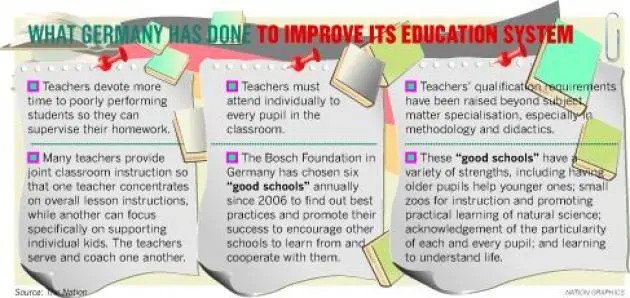
German experts told them how their country focuses more on its low-performing students, the highest proportion of students in the country.
Teachers are trained to approach every student differently, according to the experts.
Based on a poor international assessment more than a decade ago, German educationists worked to discover the weaknesses in their system and figure out how to deal with such problems, said Norbert Spitz, director of the Goethe-Institut Thailand.
He was among speakers at a national conference on “What is a Good School?” hosted by Nanmeebooks in Bangkok to celebrate its 20th anniversary.
Norbert said the first survey of the Programme for International Student Assessment (PISA) showed that German students performed below the average of OECD (Organisation for Economic Co-operation and Development) countries in 2000.
“It was called PISA Shock,” Spitz said. “The most important conclusion from the first PISA study was [we must look] for policies that helped us include those in the low performing category.”
“We have to look at the low-performing students as so many from lower social classes or lower family backgrounds don’t reach a higher educational level, only a small percentage. The family support may be weaker,” he said.
He added that teachers increased the time they spent on low-performing students so they could supervise their homework. They stayed longer every day at school. Also, Germany included the idea in the training of teachers so that they must focus on every pupil in the classroom.
In Germany, academics, teachers and headmasters, and the private sector have made recommendations to policy-makers who must ensure that all recommendations could be implemented, Spitz said.
“This is to improve the educational system [and] PISA gave us opportunities to think about our weak points in the system,” he added, “It is not at all about preparing students for the next [PISA] test, because that is a wrong approach. It is about the needs of the society for very well-educated, young generations who are able to apply knowledge that they have received in educational institutions and solve problems.”
To create a good school, Prof Peter Fauser, a former speaker for the Jury of the German School Award from the University of Jena emphasised “comprehension intensive learning” and “the second order comprehension” – a specific professional competency that made teachers realise their own way of understanding and the individual understanding of their pupils.
The most essential aspect of the procedure of the second order comprehension was an ongoing conversation and cooperation between teachers before, during and after school.
In joint classroom instruction, one teacher could concentrate the overall lessons while another teacher could focus specifically on supporting individual kids. The teachers could serve and coach one another, Fauser said.
“Schools should be like an enterprise that tries to be successful in culture and education,” he said, adding that they should also collaborate and learn from one another.
Privy Councillor Kasem Watanachai said the latest policy for Thailand’s education was to produce good people for Thai society. He said for the policy to deliver tangible results, the country must first eradicate corruption by executive-level educators and teachers, enforce harsh punishment such as dismissal of teachers indulging in wrongdoings, prevent the politicisation of educational issues, and develop curriculum and educational-performance-evaluation standards.
“Then, we will need to embrace decentralisation in educational services. We have to assign a more active role for Educational Service Area offices,” he pointed out.
Rolf Schulze, the German ambassador to Thailand, said that apart from family members, teachers had much influence over children. He said children learn not just about academic knowledge but also responsibility and life management from teachers.
“What children have learned from their teachers are tools for their future,” Schulze said.
As a result, he placed great emphasis on teacher quality. He said competent and good teachers knew that there were many solutions to the same problem and many answers to the same question. He said these teachers would also be aware of children’s different abilities and experiences.
“Good and competent teachers will respect children and encourage them to develop their potential,” Schulze said.
Utai Noothong, the director of Anubarn Si That School in Udon Thani, found this seminar extremely useful. “I am going to apply the many interesting ideas to my school’s context. I will convene a meeting of teachers to discuss the planning for improvement,” he said.
He expressed the confidence that if all school directors did the same thing, Thai society should be able to get quality schools for Thai children.
“It’s not at all a too far-fetched goal,” Utai said.
