
Still along way to go to improve the image of women in media


Play
Stereotypical bias in gender representation continues to be prevalent in the mass media in the Asia-Pacific region, according to journalists from 14 countries.
They’re taking part in a three-day media
sensitisation programme organised in Bangkok by the United Nations Entity for Gender Equality and the Empowerment of Women.
“The media just do not reflect what’s going on in society,” Voraporn Chamsanit, a feminist and director of the Women’s Well Being and Gender Justice Programme. “[But] the media can still work as a strong advocate of social justice, including gender issues.”
The breadth of current media coverage includes looking for different story lines, instead of presenting women in a stereotypical way. “Few women appear in the media as scientists,” said Varaporn, adding that news reporting often doesn’t reflect reality.
There has been greater coverage recently on domestic violence in Thailand, however, said Varaporn. On the other hand, too many “good” media stereotypes such as selfless mothers or wives can be limiting in presenting an accurate picture.
According to the 2011 Global Report on the Status of Women in the News Media in 2011, only 26.6 per cent of women media professionals globally occupy top management positions. “Stories accorded high news value are least likely to be assigned to female reporters, while those accorded lowest priority will most likely be assigned to female reporters,” the report stated.
The report also stated that reports by female journalists are more likely to challenge stereotypes than those by male reporters.
Nevertheless, women are underrepresented in the media, said Ginger Norwood, co-founder and programme manager of Chiang Mai-based International Women’s Partnership. Participants from many countries including India, China, Laos and Bangladesh said women faced barriers in attaining top or senior positions in media organisations, most of which had no gender-news desk or journalists specifically tasked with carrying out gender coverage.
Suluck Lamubol, a news reporter from prachatai.com on-line newspaper, said this event has opened up her gender perspective in news reporting in ways she has never considered.
“Usually I pay attention only to traditional content and necessary content in the news, but having attended this training, I think it’s important that any media should recognise the gender factor and mainstream gender sensitivity in news, or at least slowly create gender awareness and lessening of the socially-imposed stereotypes usually portrayed in media or advertising,” she said.
In China, where there are 300 million domestic migrant workers, there has been more media focus on the wives who are left behind. Eighteen million children are without parents because migration for work means the caring is in the hands of grandparents. As a result, many do not want to go to school.
“When these children grow up they’ll become a big problem for society,” said Luqiu Luwei Rose, news editor of the Hong Kong-based Phoenix Satellite.
Luqiu said media in Hong King and China are almost all male-dominated. “For the portrayal of women in Hong Kong, the media will be very careful because there’s a law. In China, there’s a lack of awareness, [the subject is] sexy and juicy,” said Luqiu.
Violence against Vietnam-ese women married to Chinese in Hong Kong is also not adequately reported.
In Laos, few women are part of top management in the media, said a female Lao journalist who asked not to be named. “Their main responsibility would be, at the most, chief editor, and it’s still difficult for them to be in the field because the feminist spirit is in its infancy.”
In Thailand, where some women from ethnic minority groups such as the hill tribes can’t speak Thai, greater support for capacity-building and advocacy are needed, along with media attention, said Joan Carling, secretary- general of the Chiang Mai-based Asia Indigenous People’s Pact. Some are still being evicted from the national forest as well. “When they’re thrown out of the forest, they have no food. Many end up in Chiang Mai city looking for work and many work as prostitutes and become more vulnerable to human trafficking.”
There’s also the issue of citizenship, making access to education and healthcare for some of these women impossible. “Men can become monks but women cannot,” said Carling, adding that on the other hand, there’s a lot of initiative to form self-help groups.
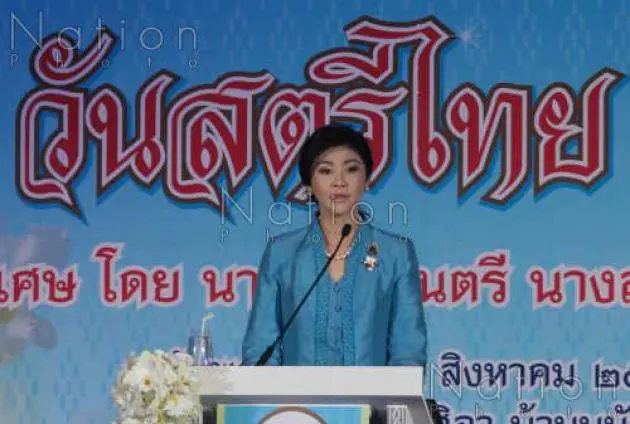
The group paid a courtesy call to Prime Minister Yingluck Shinawatra on Friday afternoon at the Gover-nment House. Yingluck said the government was pursuing many initiatives to work toward greater gender equality.
