
Row over change to historic Supreme Court
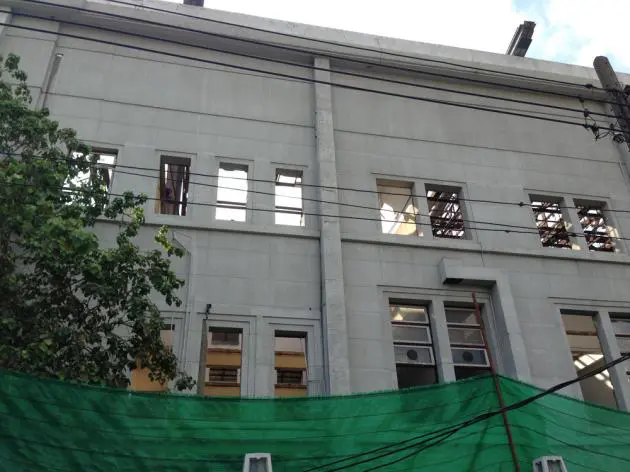


The Fine Arts Department is trying to inspect construction inside the Supreme Court's compound amid growing concern the work may endanger two registered national historical buildings.
“These registered buildings must be neither dismantled nor changed,” the department’s director-general Sahawat Naenna said yesterday.
He said the buildings might undergo interior improvement but any work of that kind must first receive approval from his department.
The reported plan to dismantle buildings inside the Supreme Court’s compound has caused public uproar. Several people have vented their frustration in the online community and demanded that such a plan, if any, be immediately scrapped.
Wirat Chinwinigkul, secretary-general of the Office of the Judiciary, has assigned Court of Justice spokesman Sittisak Wanachakit to head a panel seeking opinions from the public on the construction of the new building for the Supreme Court.
Establishment of the panel is aimed at countering the negative comments.
“I can assure you that no dismantling of the existing building has started,” Sittisak said.
He also ordered the creation of a new Facebook page yesterday to deal with the online criticism against the construction plan.
Sahawat yesterday said his department had received a letter and photos regarding the reported plan from the Association of Siamese Architects under Royal Patronage (ASA). Tarapong Srisuchart, the director of the department’s Bureau of Archaeology, has been assigned to look into the issue.
“The bureau dispatched officials to the Supreme Court’s compound a week ago but the officials were denied entry,” Sahawat said.
He said his department would urgently ask the Supreme Court for permission to check the site.
Sahawat said the Supreme Court’s representative met with him a month ago to discuss a plan to construct the new building for the court. The court’s representative was told that the two registered historical buildings were national heritage and must not be dismantled or changed.
One of these buildings is behind the statue of the Father of Thai Laws, while the other sits by the Lod Canal. These two registered national historical buildings inside the Supreme Court have received several awards, including from the ASA.
judicial history
According to conservationists, the buildings were constructed in 1939 to mark a significant milestone in Thailand’s judicial history, the so-called return of “complete judicial independence” in 1938.
In the eyes of many Thais, the Kingdom had lost some of its judicial independence when it signed the Bowring Treaty in the reign of King Rama V. Moreover, these buildings were constructed in the modern style to reflect the new ideologies of people at the time the country welcomed democracy.
“These buildings are not simply where judges work. These buildings have much relevance to Thai politics and society in the modern era,” a Facebook user said on Saturday.
A source said the dismantling of the important buildings would be completed by March or April. Hole digging and many other works related to the construction had already begun.
Wirat has insisted the court has proceeded cautiously and done everything in consultation with relevant organisations, including the Fine Arts Department.
“We first started a plan to construct a new building in 1991,” he said.
Information provided by Wirat, however, suggested the building by the Lod Canal would be dismantled.
“We will conserve the building behind the statue,” he said.
