
Klity villagers want creek cleaned quickly


Play
PCD's actions so far 'not sufficient'
Residents of Kanchanaburi’s Lower Klity Village have called on the country’s pollution-control agency to rehabilitate Klity Creek urgently after more than 14 years of suffering the effects of lead contamination caused by a nearby factory.
The call came after a visit to the village yesterday by officials from the Pollution Control Department.
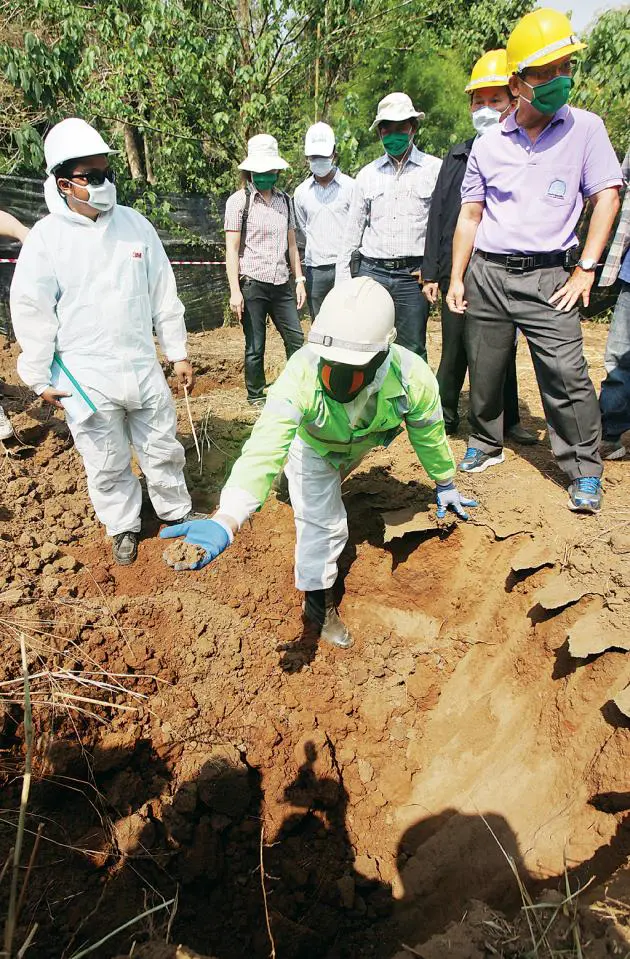
The PCD has hired Better World Green Company at a cost of Bt7 million to remove tainted sediment dredged from the creek and stored in eight underground locations along the waterway.
About 1,355 cubic metres of lead-tainted sediment are stored in the underground sites.
<iframe width="640" height="480" src="http://www.youtube.com/embed/ac7j1Gwz34Y?rel=0" frameborder="0" allowfullscreen></iframe>
Because of a lack of funds, however, as of yesterday the company had removed only 570 cubic metres of sediment from four of the underground sites.
This first batch of lead-tainted sediment will be transferred to a secure landfill in Saraburi province. This process is expected to be complete by Tuesday. PCD director-general Wichian Jungrungreon said the department would seek more funds from the government to pay for the disposal of the remainder of the sediment.
The PCD paid Bt3.8 million to 22 villagers severely affected by the lead contamination after a ruling in their favour last month by the Supreme Administrative Court.
But in the eyes of local residents, the PCD’s efforts so far have not been sufficient.
“Simply removing this lead-tainted sediment, which has been stored underground for a decade, is not enough to bring our lives back,” said Ma Ong Seang Nasuansuwan, a 49-year-old villager who lost her sight because of lead contamination.
“A large amount of lead-tainted sediment remains under the bed of the small creek,” she said.
Ya-Sue Nasuansuwan, a village leader, said local residents wanted the PCD to restore the creek to its former state within three years, as they needed to use its water for their daily lives.
“Handing out money does not resolve the existing problem,” he said.
Kamthorn Srisuwanmala, a village committee member, said the committee would use the money to set up a fund for rehabilitation of the creek and to cover medical treatment for villagers whose health has been affected by lead contamination.
Regarding the large amount of lead remaining in the creek, Wichian said his agency would come up with a plan to rehabilitate the waterway by the end of this year. The recovery process is expected to cost about Bt50 million.
“We have to listen to the opinions of local people and experts before deciding on a method to rehabilitate the creek,” Wichian said.
Surachai Trong-ngarm, director of Environmental Litigation and Advocacy for the Wants (EnLAW), said he would keep a close eye on the PCD’s recovery process. If there is no progress, he will ask the Supreme Administrative Court to force the PCD to do its job.
Ply Pirom, campaign manager at Greenpeace Southeast Asia, said the PCD should dredge all lead-tainted sediment remaining in the river to restore it as near as possible to its proper condition at quickly as it can.
The operation following the Supreme Administrative Court’s order is among measures planned to rehabilitate the creek, which was contaminated by lead-tainted wastewater from a nearby ore-dressing factory. The company that operated the plant closed it in 1988 but took insufficient steps to avoid pollution, installing a simple check dam made of rocks to keep lead-tainted sediment flowing to the 12-kilometre-long creek, and dredging only a portion of the sediment for underground storage.
The dredging effort was not sufficient to rehabilitate the creek, which continues to show high levels of lead contamination.
