
Five-year deadline 'can't be met'


Play
Govt's dams, flood plans face tough obstacles, RID warns
It will be impossible for the government to meet the five-year deadline for its ambitious Bt350-billion water and flood management plans – as at least 16 dam projects face environmental hurdles and strong opposition from local communities, according to the Royal Irrigation Department (RID).
“The strong opposition from local communities over land expropriation is the most challenging obstacle for us to worry about to complete this mega project,” RID director-general Lertviroj Kowattana said.
The 16 dam projects are among 28 listed under the government’s mega-water and flood prevention construction plan, scheduled to be completed within five years.
According to Lertviroj, the 28 dam projects could retain 2,495 million cubic metres of water in major river basins nationwide, including in the northern part of Thailand. They include the Ping, Yom, Nan, Sakraekrang, and Pasak.
Three of six contenders in the bidding are the Korea Water Resources Corp, Thai-Japanese Joint Venture and ITD-Power China Joint Venture.
They are required to submit final plans for water and flood management infrastructure and systems to the Prime Minister’s Office Ministry by May 3. The terms of reference for these projects were received in March.
The process for selecting the successful bidders will be completed by the end of June.
Next week the six contenders for the water and flood prevention management projects have to submit final proposals to the PM’s Office. The government will spend about 30 days selecting eligible contenders to run the projects.
But in Lertviroj’s opinion, all 28 dam projects in the government’s mega-water and flood management and prevention plans are not new ideas proposed by private firms.
The RID has been conducting studies, including feasibility and Environmental Impact Assessment (EIA) on these projects for many years. The government then took all the projects and put them into its mega-scheme, he said.
Out of the 28 dams, 11 projects require feasibility studies and EIA evaluation of their value. Two of them are waiting for the green light for EIA reports from the Office of Natural Resources and Environmental Policy and Planning (ONEP) and three dam projects are expected to be located inside World Heritage sites.
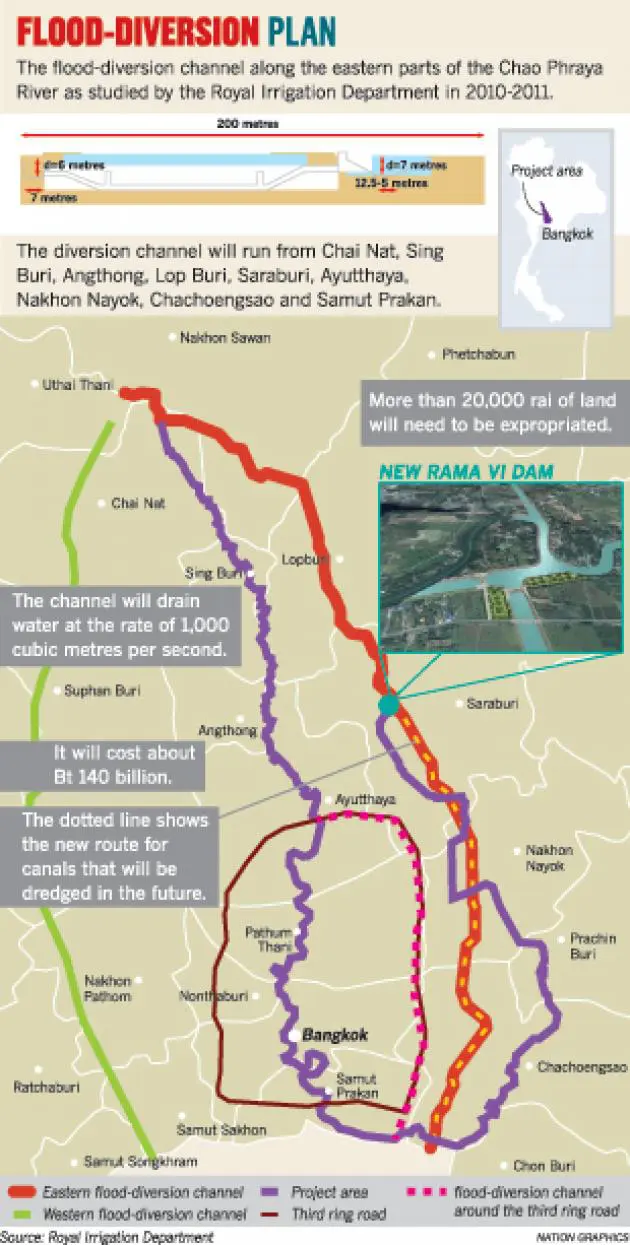
Only 12 dam projects are ready to undergo construction and likely to be completed within 5 years – if the government can get eligible bidders by June, as well as a flood diversion channel in the eastern part of the Chao Phraya basin with the capacity to drain water at 300 cubic metres per second from the main river to the sea.
These projects did not require EIA reports and would not expropriate large areas of land owned by local people, he said. Moreover, the RID had already conducted a design study for these projects, which were ready to go.
For the flood diversion channel in the eastern area of the Chao Phraya River, Lertiviroj said the RID had conducted a study on building a diversion channel with the capacity to drain 1,000 cubic metres of water per second. But this project would expropriate at least 20,000 rai of land from local people. So, the government had reduced its scale from 1,000 cubic metres per second to 300 cubic metres, as it wanted to start the project as soon as possible after determining final bidders.
“The only thing that the bid-winning construction firms have to do is to conduct survey studies and building designs, then they can go ahead with the construction plans,” he said.
However, he accepted that the process to conduct the feasibility study, EIA, EHIA, and get approval from relevant agencies for the rest of the dam projects would take several years, especially the land expropriation programme.
ONEP secretary-general Santi Boonprakub said his agency would study the EIA and EHIA reports on these dam projects strictly and spend at least 105 days working on each project.
In a related development, a network of eight environmental organisations and local people in the northern part of Thailand issued a statement strongly opposing the government’s water and flood management projects, saying they would affect natural resources and local people’s livelihoods.
