
Teacher trainers key to schools'success


Play
Finnish expert shares insights in talk at Chulalongkorn
Everybody has access to good local schools in Finland – so, parents don’t have to be concerned about the selection of schools for their children, a Finnish professor who has been a key contributor to the international and Finnish education landscape told Thai educators last week.
“We have low, intermediate and advanced groups of students at schools. Teachers have to take care of different groups,” said Prof Hannele Niemi, Professor of Education at the Faculty of Behavioural Sciences at University of Helsinki.
Her answer would seem to explain why every school in Finland is good for its students.
“It is very difficult to act on all children’s needs. In a teacher’s education time, he or she can produce only some basic tools on how to differentiate learning, but teachers need to keep learning all the time in their careers. That’s why we nowadays see first year teachers needing extra tutoring or mentoring so they can perform in a better way.
“Also, later on, teachers need in-service training and cooperation with special-needs teachers, as well to help students who have difficulties. So there is no individual who is totally prepared for everything. They need cooperation, help, and all the time the learning of new methods. As we get to know more and more about students’ learning problems, the teachers’ work gets more complicated and then we can understand better those difficulties,” she said.
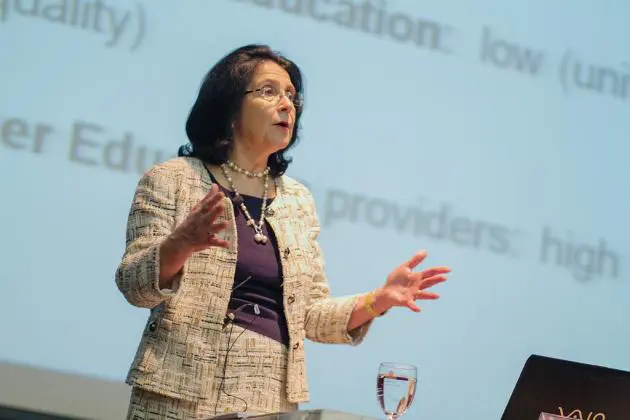
Niemi gave a public lecture on Teacher Educators’ Leadership and National Education Policy at Chulalongkorn University last week. It was hosted by the university’s Faculty of Education with support from Pico (Thailand) to provide an opportunity for Thai educators and interested people to learn the good lessons offered by Finland.
She also disclosed that apart from having systems at schools to support students with different difficulties, teachers and teacher educators are key individuals with a powerful role in education development.
Teacher educators are counsellors, supervisors and mentors for teachers in Finland. They provide teachers with formal pedagogical training and have a high content knowledge.
“Teachers and teacher educators play a crucial role in Finland. Why? One major issue is that they are responsible for several important issues in education. They are responsible for developing local curriculum. That means they need understanding of how teaching and learning should be organised in schools and how that should be planned in such a way that we can implement our important policy principles of equity, meaning every child should have the right to learn and have a good education.
“So, that is a teacher’s work in local schools. They take care of structural issues and large curriculum issues. They care also for personal relationships among children and their future. They are influencing students’ future.”
Niemi said teacher educators were responsible for teachers having the skills to do this and to help forthcoming teachers understand their multifaceted roles. It was not only teaching maths or language, it was much more – taking care of the whole child, and cooperating with their parents, being ethically committed in their work, implementing the values which are in the national core curriculum. (Teachers and trainers have a special role in Finland. At national discussions and working groups they are often active contributors.)
It is known worldwide that Finland is able to recruit high academic achievers to be trained to become its high quality teachers. Not only do the individuals’ achievements matter, but also a research-based approach has been behind the success of Finnish educational development.
“Teachers are also researchers in Finland,” Niemi said. “The research means they have the capacity to make observations and they can understand how knowledge can be created. What is knowledge? It’s not only something we transmit from one to other. It’s something that we create. One very important way to create knowledge is through research, which means systematic inquiring, analysing, then making conclusions and decisions. Trainers can have attitudes like researchers – they question, analyse, think about why things happen, what they should do and what they could do together in schools to make changes.”
Niemi says an important method is action research. There are small developmental projects that teachers can present in their education time and later on. Also, teacher educators can have research projects to work on as a group and then try to find out new practices, for example how to work with new technology and how students learn with iPads and different social media tools.
Teacher educators are regarded as researchers or experts developing teaching using the latest research. Their research work is connected to developing teaching and learning in schools, she said.
