
Social media and Internet access gives Thais a voice: Kittiratt


Play
Some 30 per cent of Thais use social media while 40 per cent have Internet access - creating a new form of political influence for ordinary people, Deputy Premier and Finance Minister Kittiratt Na-Ranong said yesterday.
This new political influence, he said, “gives true voice to the people and helped connect activists”.
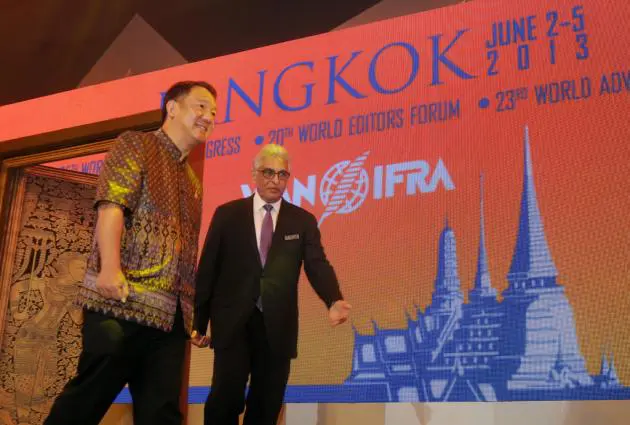
Kittiratt gave a keynote address at the official opening of the 65th Congress of the World Association of Newspapers and News Publishers (WAN-IFRA), which is being held in Bangkok at Centara Grand Hotel and Central World.
Kittiratt said 60 per cent of Thai people were still not connected to the Internet and considered underprivileged although they still have access to printed newspapers.
The deputy PM said while facing challenges from online media and television, Thai newspapers remained important to the public and could not be easily duplicated by television or online outlets.
“Newspapers can reach people in almost all areas and newspapers remain a central point to which all the news is filtered,” he said, adding that a balanced view, credibility and integrity were found in papers.
“In Thailand, the press is free to speak… the government has accepted that,” he said, adding that there could be no democracy without freedom of the press.
Jacob Matthew, WAN-IFRA president, highlighted Thailand’s lese majeste law during his opening address. Matthew said the law had been misused and led to a climate of fear in the Kingdom given the imprisonment of citizens and an editor. The law carries a minimum penalty of three years in jail and a maximum penalty of 15 years.
“The lese majeste law allows anyone to file a lese majeste case – anyone can accuse anyone. The misuse of the lese majeste law has created a climate of fear,” he said.
“WAN-IFRA is deeply concerned of its misuse and the arrest of an editor and citizens,” he said, while later praising HM the King for his annual birthday speech in 2005, in which the King stated that he could be criticised.
Matthew urges the government of Thailand and others elsewhere to protect freedom of speech on the Internet.
