
Army fumes over 'inhuman attack'


Play
Eight soldiers killed, two injured as military truck is destroyed by powerful bomb in Yala; Prayuth urges people to denounce such acts as doubts arise about fragile peace process
The Army and the Internal Security Operations Command (Isoc) yesterday strongly denounced the latest insurgent attack in the deep South that left eight soldiers dead and two others injured.
The latest attack raised questions over the durability of a fragile peace process that aims to end the near-decade long insurgency in the restive Muslim-majority region.
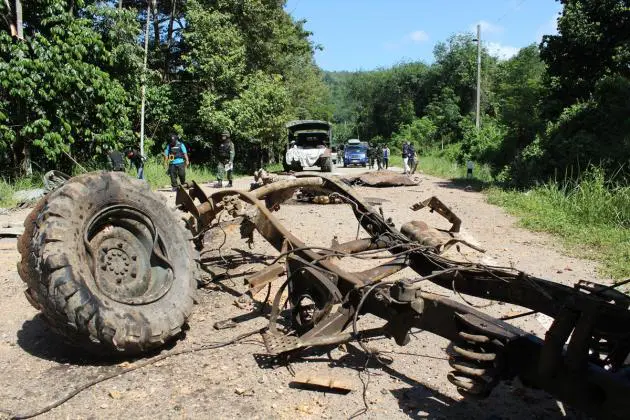
A powerful roadside explosion occurred in Yala’s Krongpinang district in the morning when a military truck carrying the soldiers was passing. The truck was almost completely destroyed by the home-made bomb, concealed in two fire extinguishers and believed by experts to contain 50 kilograms of explosives each.
The soldiers were returning to their camp in Nakhon Sawan after completing their time in the deep South.
Army commander-in-chief General Prayuth Chan-ocha described the latest insurgent attack as an “inhuman act” and called on the public to denounce such acts, according to Army deputy spokesman Colonel Winchai Suwari.
He said most people in the three southern border provinces and other parts of the country disagreed with such acts of violence by the insurgents.
The Isoc’s Southern Advance Office yesterday issued a statement denouncing the violent attack, saying it was caused by repeated distortions of religious principles
by certain extremists. The state-ment said the latest attack would deeply affect the feelings of local residents.
Meanwhile, local authorities ordered increased security mea-sures in the southern border provinces following the deadly attack, which came shortly after an insurgent attack in nearby Songkhla province.
Attacks occur almost daily despite the government’s ongoing efforts to engage in talks with Muslim militants. Earlier this month, the Thai government and Muslim separatist negotiators said they hoped to curb violence in the region during the upcoming Muslim fasting month.
Thailand began talks with some separatist leaders in April, but other groups have not participated and regular attacks continue in the Muslim-majority region of Narathiwat, Pattani and Yala provinces.
More than 5,700 people have been killed in a festering insurgency in Thailand’s Muslim-majority deep South provinces, but optimism for peace flickered recently after talks between authorities and some rebel groups, including the Barisan Revolusi Nasional (BRN).
The bombing, among the deadliest attacks by rebels on Thai security forces in recent years, ripped through the military truck.
“It was a very powerful bomb that completely destroyed the truck,” spokesman Colonel Pramote Promin said.
“Ten soldiers were in the truck. Eight died and two were wounded,” he said, adding that two villagers were also injured in the blast.
“It’s likely the biggest loss for our military so far this year.”
Local media reports said the bomb weighed more than 50 kilograms, backing up the view of experts who say the rebels are becoming increasingly sophisticated in carrying out bomb attacks.
Near-daily assaults on security forces and civilians have continued despite a successful round of talks on June 14 that saw both sides agree to work towards curbing violence over Ramadan.
But prospects for a significant reduction in violence appeared to receive a blow last week after the BRN called for the Army to return to their bases during Ramadan in exchange for a ceasefire during the holy month, a condition swiftly rejected by the Thai government.
Questions also linger over whether the BRN representatives negotiating with Thai authorities are capable of reining-in violence by an increasingly battle-hardened and brutal younger generation of rebels believed to be behind much of the worst violence in Yala, Narathiwat and Pattani provinces.
The majority of lives lost due to the insurgency are those of civilians. Many locals complain of a long history of discrimination by Thai authorities in the Buddhist-majority nation.
Security personnel and those connected with the government – including teachers – are regularly targeted in the attacks, as well as Muslims perceived to be collaborating with the authorities.
