
'Our role is to help push for peace'


Play
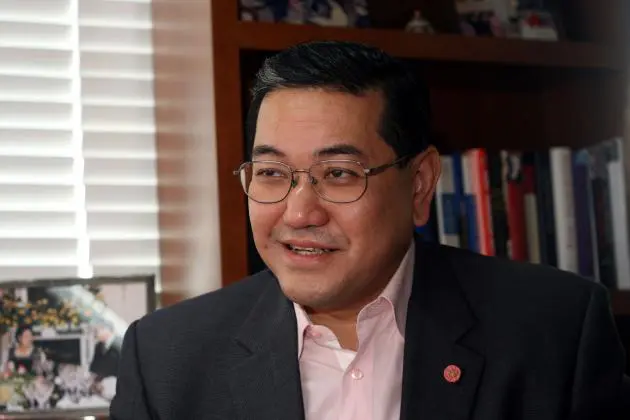
Former foreign minister Surakiart outlines his vision
The thai prime minister should play the role of a bridge to achieve peace and reconciliation in dispute-ridden countries in the region, Surakiart Sathirathai, a former deputy premier said on Friday.
“The history of Thai foreign policy is that we always act as a coordinator for parties to a conflict to achieve better understanding,” Surakiart said in an address on “Future Asia” at a dinner banquet hosted by The Nation in celebration of its 43rd anniversary.
Suthichai Yoon, chairman of Nation Multimedia Group, had asked Surakiart during the session that if he were the premier, what would his role be.
Surakiart served as the foreign minister during Thaksin Shinawatra’s administration from 2001-05. He enhanced the role of Thailand through various Thai-sponsored regional frameworks including the Ayeyarwaddy-Chao Phraya-Mekong Economic Cooperation Strategy (ACMECS) and the Asia Cooperation Dialogue (ACD).
He is the chairman of the Asian Peace and Reconciliation Council (APRC) set up last year as a non-government organisation promoting peace and reconciliation in Asia.
“I think Thailand is one of the countries that are in a very good position to work with the APRC to create a peace dialogue,” he said.
“Frankly speaking, for the situation in the South, witnessing the peace process in the Philippines, helping and creating the peace process in Myanmar, helping leaders of countries which have conflicts, especially maritime boundary conflicts, to talk to one another.”
Thailand can help ease tension through “quiet diplomacy”.
“Thailand is one of the countries that understand Asian characteristics very well,” he said. “This would be the first project for Thailand to have a role to play to reduce tension, opening up the opportunity for economic activities to proceed smoothly.”
Asia is the growth engine of the 21st century, as capital and other resources moving into the region. Asia in the future would face a number of challenges.
Regional cooperation and integration, as Asia moves closer to |liberalising trade, investment services and the movement of capital, would affect domestic industries.
The linking up of many regional and subregional organisations would need to cope with differences and diversities.
Asia is rising but a major problem for the region is how to handle its rapid growth. Some individual countries might just open their economies and lack infrastructure while some countries are growing faster than they can handle. Asia also faces global mega-trends such an ageing society, urbanisation, food and energy shortages and climate change.
Asia is now facing the problem of major polar competition. While China is building its presence in the region, the US has a hedging policy surrounding China’s presence.
“The challenge is how Asia can create a balance of influences among all major players in the region,” he said.
The territorial conflict and tensions are other factors for the future of Asia. Domestic and regional conflicts such as in Thailand and Cambodia, the southern Philippines and South China Sea, where five Asean members have disputes with China, still exist.
While military modernisation in Asia might not be intended for territorial expansion by the use of force, the danger of an accident due to a “miscalculation” leading to a military clash remained, he said.
“The challenge is clear. How can Asia devise mechanisms to avoid conflict, reduce tension and resolve conflict, especially on issues of sovereignty, where nationalistic emotions can easily erupt and get out of hand.”
Note: “Business Visions 2020” |gathered from the event will be |published tomorrow.
