
New strategy adopted to fight dengue: spray areas promptly


Play
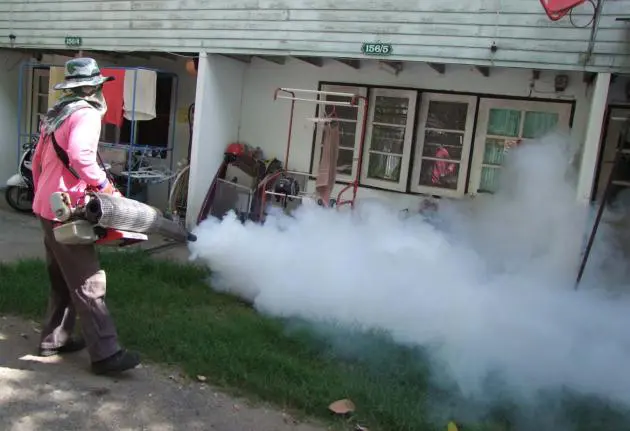
THE PUBLIC Health Ministry has announced a new protocol that will be used to control the spread of dengue fever and destroy mosquito larvae.
Public Health Minister Pradit Sinthawanarong said his ministry would use the 3-3-1 protocol to control the disease. Under the protocol, hospitals must report to the area disease control department within three hours every time a dengue-fever patient is admitted. Mosquito larvae in the infected area would then be destroyed and an investigation team would then move in. It would be given one day to bring the virus in the area under control.
Pradit’s deputy, Sopon Mekthon, said that 45 per cent of mosquito larvae was found on school premises, while 29 per cent had been reported at hospitals. The two locations were the most common for mosquito larvae and should therefore be targeted in each province for mosquito nests, Sopon said.
Mosquito larvae needs to be killed every seven days in order to keep control of the disease.
Deputy permanent secretary for Public Health, Sopon Mekthon, said it was a good sign that the number of dengue-fever patients appeared to be dropping. From July 9 to 16, up to 6,000 dengue fever cases had been reported, compared to some 8,000 patients the week before.
The provinces with the highest incidence of dengue were: Bangkok, Chiang Mai, Songkhla, Chiang Rai, Nakhon Ratchasima, Nakhon Si Thammarat, Phetchabun, Si Sa Ket, Roi Et and Nakhon Phanom.
People who experience a high fever that does not return to normal within two days, should see a doctor, he said.
