
TPBS newsman to explain his Facebook postings on Friday


Play
Lawyers, rights expert slam police for saying "like" or "Share" is a crime
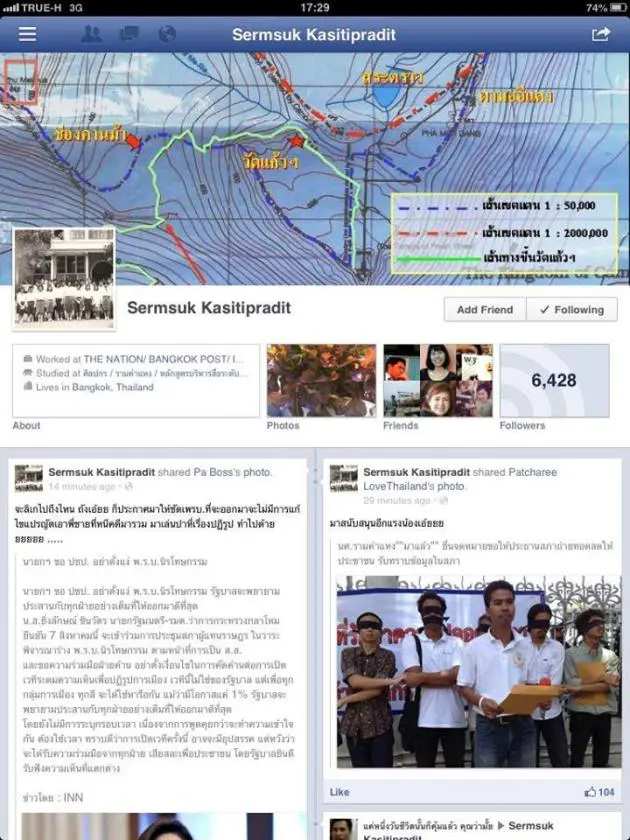
THAI PBS news editor Sermsuk Kasitipradit said he would go and give information to police on Friday after being summonsed to clarify a post he made on Facebook.
Many social media users have voiced support for Sermsuk and opposed a police statement that simply clicking “Like” or “Share” on Facebook could be a crime.
Legal experts and a human rights commissioner have also questioned the police’s action.
Pol Maj-General Pisit Pao-in, commander of the Technology Crime Suppression Division, said three other people summoned this week had not contacted police but closed their Facebook accounts.
Presidents of the National Press Council Chakkrish Permpool, who is also a legal expert, said Sermsuk referred to a message from a leaflet, and also posted that he disagreed.
Therefore, there was no proof of any intent by Sermsuk to disseminate a message that was threatening to national security.
“I have both factual and legal reasons to support my affirmation that Sermsuk must defy this abuse of state power. This is a fight for the rights and freedom of the press, not any particular person,” he said.
‘Statement unacceptable’
Human Rights Commissioner Niran Pitakwatchara also disagreed with the police’s conduct. “The objective of the Computer Crime Act is to prevent violation related to computer crimes. But if it is used over the expression of ‘different’ opinions (from the state), it can be deemed violation,” he said.
Mark Charoenwong, a public prosecutor at the International Affairs Department in the Office of the Attorney General, said people who click “like” on FB posts that cause public panic were not guilty until proven in court that they did this with the intention to inform friends, or to get friends to transfer the information in question.
If they clicked like without knowing the information would spread among friends, or clicked like for their own knowledge, they had not done wrong. This was because people on social media networks do not have the same level of computer literacy.
On Monday, Pisit said the four suspects posted messages via social media, saying they anticipated a coup and urged people to stock up on food and water in preparation for a shortage. And such statements could put people in a state of panic.
Pisit said the four may have breached Article 14 of the National Computer Act and Article 116 of the Criminal Law.
If found guilty, they could be subject to up to five years in jail and a fine up to Bt100,000. And anyone who pressed “Like” or shared the messages could also be liable to such punishment.
