
Risk to teachers is the key factor


Play
But families in deep South still want best for kids
In the face of the non-stop violence, children and teachers in the deep South are of course praying for peace. But when it comes to educational problems and needs, their situation is pretty much the same as other parts of the country.
Parents want to send their children to the best school and even to tutorial classes.
Students hope for scholarships. School administrators complain about the shortage of teaching staff. Other stakeholders suggest that teachers should focus on students, not their qualification upgrades for higher pay, and that children should master some foreign languages.
Earlier this month, Education Minister Chaturon Chaisaeng went to Pattani to listen first-hand to people’s opinions on education.
“The Education Ministry will address urgent needs right away if possible,” Chaturon pledged in front of more than 1,000 participants at a seminar on educational development in the southern border provinces.
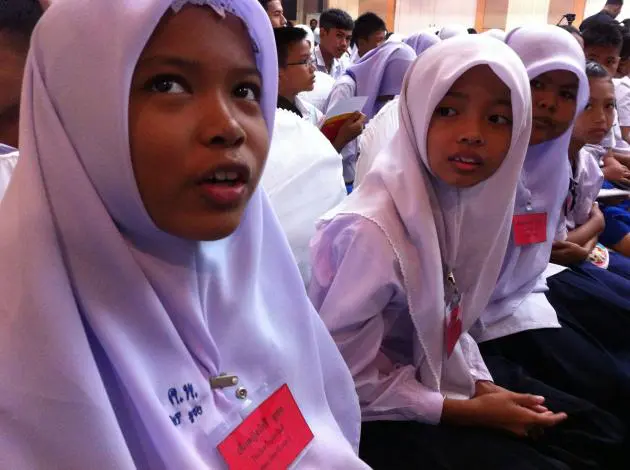
The attendees were students, parents, teachers, administrators and various other stakeholders.
At the start of the seminar, security officials including an explosive-ordnance-disposal team showed up to sweep the venue.
“ Teachers must be safe. If the teachers are not killed, they can deliver quality students,” said Boonsom Thongsriprai, chairman of the Federation of Teachers in Southern Border Provinces. This month saw several bloody attacks on teachers. The latest victim was gunned down when he was returning home after school. Several schools in the deep South suspended classes. That had disrupted children’s studies.
“As long as teachers’ lives are at risk, it’s hard to expect students here to get the most out of educational services,” he said.
Zamari Jehmae, a parent from Narathiwat, said he now wants to send his son to a school in town because it seemed safer there. With the safer environment, tutorial classes were available in the evening and children there could gain more knowledge.
“You cannot expect anyone to run or sit in an evening tutorial class in my village. By nightfall, everyone just stays at home (for their safety),” he said.
A 2012 survey showed that 33.7 per cent of Prathom-6 graduates in the three southernmost provinces were illiterate. In 2011, Mathayom-6 students in the deep South also performed worse than the their peers in the Ordinary National Educational Test (Onet).
For example, the deep-South students at state schools scored just 40 per cent and local students at private schools scored a mere 33.4 per cent in Onet for Thai language. The national average was about 42 per cent.
In maths, the deep-South students at state schools scored 21 per cent and local students at private schools just 17 per cent against the national average of 22.7 per cent.
Matorhay Jaheng, an imam and the chairman of a school board in Pattani, said private schools in the region suffered from high turnover, which caused discontinuity in teaching and conducting classes.
The government should introduce special measures to provide quality teachers for private schools in the area, he said.
Sanusi Benjaman, heads the Private Education Office in Nong Chik district, said teachers at private schools would usually try to apply for teaching jobs in the private sector and once their application was accepted, they moved to state schools.
“So private schools here serve very much like places for new graduates to practise their teaching skills,” he said.
The government pays 85 per cent of the salary for teachers at private schools in the far South plus a hazard allowance.
Although the deep South is plagued with unrest, it looks set to benefit from the emergence of the Asean Economic Community in 2015.
Many residents use a Malay dialect in their daily life, so they could interact well with Malay speakers in Indonesia, Malaysia and Brunei.
“If we develop Malay fluency, we can be a hub here,” Matorhay said.
Jaru Deekaew, a sixth grader, believes the government should urgently equip local students with good foreign-language skills.
“We need to connect with other Asean nations,” he said.
