
Chaturon looks abroad for guidance


Play
Minister wants to talk to stakeholders to try to get real education reform happening
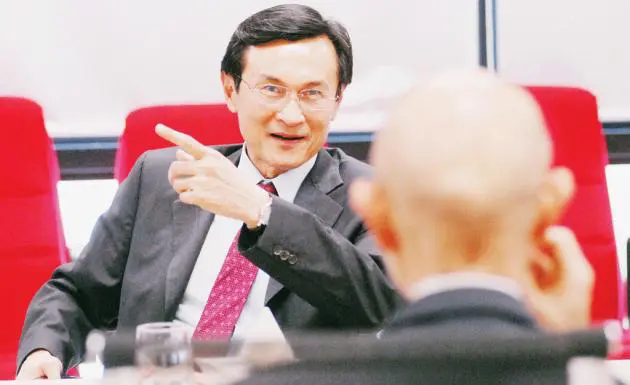
Education Minister Chaturon Chaisang will count on international assessments like TOEFL scores and PISA ranking in determining whether Thailand’s education is rising to world-class standards.
Educational reform under his supervision would start making real moves next month and results, he said, should be visible within two years.
“Because we want the country’s education to be on par with international standards, we have to turn to international rankings and the like. If we want to know how good English teaching is here, we need to look at Thai students’ TOEFL scores,” Chaturon said in an exclusive interview recently with Nation Multimedia Group, which publishes The Nation.
Chaturon said he had learnt English as a student in Thailand for 16 years but had never had any real English conversation during that period. “So, I think I know where the problem lies. We have to change the learning process,” he said.
The education minister was determined to use the results from international assessments as key indicators, drivers, and goals.
“When results show Thailand’s education is in a bad shape, I will ask all stakeholders here to look at the problems and join the educational reform,” Chaturon said. “Our goals are clear. Our scores or rankings should improve in the international assessments.”
The minister has clearly planned to count on widely-recognised tests like TOEFL and PISA. TOEFL (Test of English as a Foreign Language) is one of most widely respected English-language tests in the world. And PISA (Programme for International Student Assessment) is a worldwide study by the Organisation for Economic Co-operation and Development (OECD) in member and non-member nations of 15-year-old pupils’ scholastic performance in maths, science, and reading.
Thai children have not fared so well in these tests to date – a fact that reflects the many flaws in Thailand’s educational system. Chaturon now hopes to engage all stakeholders in the educational reform.
He believed that together, they would be able to get well-rounded information and introduce real solutions for the country’s long-standing educational problems.
The university admission system was one of the things the new minister wished to tackle. Chaturon’s current tenure started just a few months ago. In his opinion, the current university admission system has aggravated the inequality problem among children even further in terms of educational opportunities.
Up to now, universities have relied heavily on a direct admission system. Some of the higher-educational institutes have allocated up to 80 per cent of their available seats to applicants submitting applications directly to them. Although the central university admission system is in place, it has not played a big role as the so-called “university entrance exam” did in the past.
The university entrance exam long facilitated a system through which university applicants sat the exam only once. Their scores then determined whether they had a chance to further their education at preferred institutes.
Back then, it generated widespread criticism that the exam put much pressure on students who felt this one exam would change their lives for the better or worse. Many critics also felt that children of the rich could afford tutorial classes and thus could do better in the exam and enjoy a greater chance of getting into the best universities.
“Now, children of the rich can take many exams to gain greater chances because universities have accepted applications directly almost throughout the year,” Chaturon pointed out.
He believed if the Ordinary National Educational Test (Onet) standard improved, problems about the university admission system may ease.
He said the Office of Higher Education Commission would soon hold a meeting to discuss problems and explore solutions. The National Institute of Educational Testing Service (NIETS) is now responsible for organising the Onet, which has often attracted controversy.
“All elements are linked. Testing must reflect the curriculum and what students have learnt,” Chaturon said.
On the curriculum, he said efforts to improve it had already taken off.
“We have looked at successful cases in foreign countries too to see which models will suit our context best,” he said.
Asked whether the frequent changes in the man at the helm of the Education Ministry had disrupted the country’s ongoing educational reform, Chaturon downplayed the concerns.
“When it comes to the educational issue, things also depend on society,” he said.
