
Debate over criteria used to assess quality of educational institutes


Play
Key players such as employers need to be considered, expert says
In Thailand, quality assessments of educational institutes have been going on for over a decade, but to date the results have been little used.
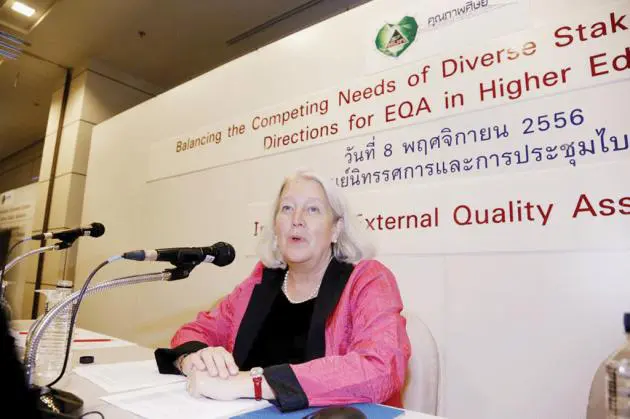
“Quality is perceptual. It depends on how it is valued by the people who are its consumers,” Dr Carol L Bobby, a keynote speaker, pointed out during a recent international conference in Bangkok.
She explained that “quality” was a complex term especially considering the diversity of stakeholders and their range of different needs that bear on the performance of an educational institution.
Her words underlined the need for Thailand’s Office for National Education Standards and Quality Assessment, or ONESQA, to review its past criteria and do more with the practical utilisation of its assessments.
Held at the Bangkok International Trade and Exhibition Centre (Bitec), the two-day conference attracted more than 5,000 participants.
Bobby is the president of INQAAHE, (International Network for Quality Assurance Agencies in Higher Education) and executive director of the Council for Accreditation of Counseling @ Related Educational Programmes (CACREP).
She said quality assurance plays a key role in setting standards of performance. Most quality assurance criteria have been developed based on concepts such as performance excellence, value for money spent, improvement in performance, or serving regulatory requirements.
But like the word “quality”, which Bobby noted was complex, she said quality assessments of education required new innovative and flexible approaches in measuring student-focused outcomes.
Phongthep Thepkanjana, who presided over the conference’s opening ceremony, said the success of ONESQA’s mission relied on whether stakeholders – such as students, parents, schools and teachers – used its assessment results.
ONESQA is now seeking to better address the diverse needs of learners and other stakeholders.
“Indicators in our upcoming and fourth round of assessments are based on well-rounded information from all relevant organisations,” ONESQA chairman Dr Mondhon Sanguansermsri said.
The fourth round will run from 2016 to 2020.
At the ONESQA-hosted Annual International Academic Conference on “Education Quality Assurance” under the concept “Student quality a reflection of teacher quality”, ONESQA director Prof Dr Channarong Pornrungroj explained that the new indicators are designed to ensure that Thais prepare for the start of the Asean Economic Community (AEC) in 2015 and the changes it will bring.
Such moves correspond well with Dr Bobby’s suggestion that relevant parties must pay attention to these changes and gauge the possible impact of such changes on education to avoid a possible “future shock”.
With its constant improvements, ONESQA has expressed a hope that its assessment results will gain widespread use.
For example, it hopes parents and students will use its assessment results in selecting an educational institution.
“We will publish detailed results from the fourth round of assessments on our website,” Mondhon added, explaining that the results would be shown by programmes not just by institute.
He said students would have reliable information on institutes’ quality, regardless of educational levels.
Mondhon insisted that assessors deployed by ONESQA were reliable.
“When we receive complaints about any assessor, we seriously investigate and close down problematic assessment centres,” he said.
He said he hoped educational institutes would take ONESQA assessment results seriously.
“We are like an ‘education doctor’. We can diagnose your symptoms, but whether those [undesirable] symptoms will end depends on whether the patients [educational institutes] agree to take better care of their bodies,” Mondhon said.
According to Channarong, ONESQA expects students to possess quality, morality and grace. As the quality of students is a reflection of teacher quality, it is necessary that educational institutes take concrete steps to boost the quality of teachers too.
Commenting on ONESQA’s work, Phongthep emphasised that it should develop an assessment system, which encouraged co-operation, rather than competition.
“If relevant parties join hands, benefits will be greater,” he pointed out.
In her speech, Dr Bobby proposed that relationships need to be fostered with stakeholders of interest, especially potential employers. “A new vision that focuses on relationships where feedback can be made of what is working and what isn’t, so that necessary changes can be made,” she said.
She described potential employers as important stakeholders, who were key players in setting the standards of performance required of graduates.
