
Has Suthep thought through his political goals?


Play
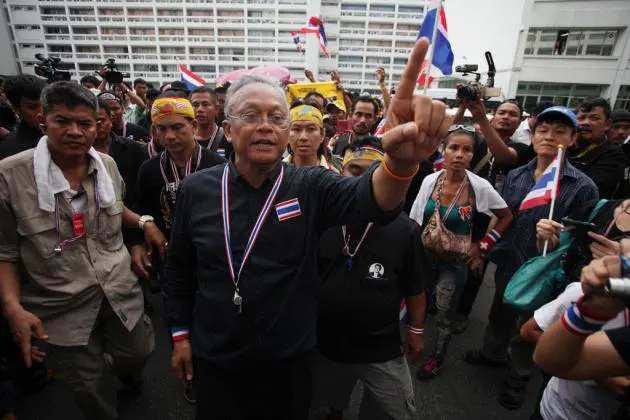
The fact that protest leader Suthep Thaugsuban, a former Democrat MP, has stepped up his recent rallying many times - and his statement on Sunday that he would not stop, even if Prime Minister Yingluck Shinawatra resigned or dissolved the House - has many
“What’s the point?” they ask.
There are many questions for protest leader Suthep to clarify. The definition of “the Thaksin regime”, his protest target, is one of them.
From the beginning almost a month ago, the number of Suthep-led protesters has fluctuated. It first peaked when the people came out against the blanket amnesty bill, then dropped after the government announced a retreat and the Senate rejected the bill – while Suthep called for civil disobedience and stepped up the rally against “the Thaksin regime”.
He later announced Sunday November 24 as the big day on which one million people would come out and join the protest.
The atmosphere seemed to have calmed down until the Parliament president and hundreds of parliamentarians announced their rejection of the power of the Constitutional Court. Last week the court ruled that the charter amendment on the system of selecting senators, proposed and pushed by the government MPs and some senators, was unconstitutional, prompting the red shirts to rally against the court.
The number of protesters joining the protests then became historic. Suthep yesterday led the protesters to march on government agencies and call on officials to take his side.
He has hinted his protest would end within three days, saying either he or his rival would have to go. If so, what can his plan be?
Will he find a cause to step up the rally again and force the government to stop working within three days? Can it be the censure debate and impeachment against Yingluck?
Or else will he bow out of the rally? In this case, how will he evaluate his achievement?
What is his plan after that? How will Thailand be governed afterwards?
If the House is dissolved, what will the next election bring? How can Thais be sure there would not be another rally, either if Pheu Thai comes back or otherwise?
The historic number of protesters comprised not only pro-Democrats. Many said they did not come because of the Democrats but because they could not accept what the government had done.
Suthep must keep in mind that illegitimate or excessive measures will only result in a drop in support.
Regardless of Suthep’s plan or non-plan, there is one thing the protesters have expressed clearly: they do not accept cheating, corruption, conflict of interest or abuse of power.
If the government continues its administration and has a chance to prove itself, it should think really carefully before doing anything that can be considered among the ill deeds listed above.
Thailand’s political divisiveness has come and gone in a vicious cycle. All opposing sides, as well as political critics, have proposed political reform. The question is how?
The government’s reform forum has been stagnant and some participants have withdrawn. It is, just as in many forums on politics nowadays, a question of trust, openness and fairness, and the possibility of how the results would be turned into practice.
In fact, the forums can lead to endless arguments over the definition of issues and the objectives or goals of discussion in the view of various political groups.
Prolonged protests, defiance of the courts and political divisiveness are not healthy for the country.
It is for Thai people to think harder and harder about what they really want. We cannot just let politicians lead us to somewhere or something we don’t know or don’t want.
