
Energy reform debate ends in stalemate


Play
Thailand's most updated English news website, newspaper english, breaking news : The Nation
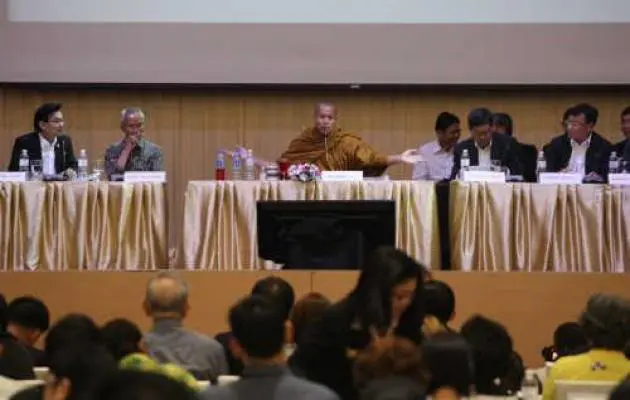
ENERGY REFORM advocates yesterday met energy company executives and technocrats for the first time in a climate of distrust at the Army Club.
The event was blessed by the junta, which sent a representative to listen, but there was no breakthrough or agreement.
The meeting was moderated by a prominent leader of a faction of the People’s Democratic Reform Committee, monk Luang Pu Buddha Issara, who charged up the proceedings at times with his provocative remarks.
“Anyone who lies [here] will go to prison. Buddha Issara won’t let you off the hook,” the monk said at one point, only to acknowledge later: “We argued back and forth but we failed to arrive at any agreement.”
As the atmosphere became tense, he said, “You guys please hurry and make a brief statement, I need to go out for a pee,” before leaving in the middle of a session.
Although the conference reached no conclusion, the monk said proposals made at the forum would eventually be sent to the National Council for Peace and Order.
“Let us not rush [the NCPO]. We have been wanting to hold such a forum for a long time,” said energy reform advocate Veera Somkwamkid, who was released just last week from detention over his energy campaign.
Top executives from PTT, Chevron (Thailand) and Bangchak Petroleum were on the receiving end and often subjected to questions and accused of placing their benefits above public interests.
The meeting turned acrimonious with one executive, Manoon Siriwan, senior executive vice president of marketing at Bangchak Petroleum Public Co, telling the more than 1,000 participants at the question and answer session organised by the Petroleum Institute of Thailand, that he was not a defendant in a legal proceeding.
“Don’t pose questions to me as if I am a defendant. I am not a defendant,” he told one energy advocate on the same panel who asked him a question in a hostile tone.
Much of the distrust and angst was squarely focused on PTT. However, Piyasvasti Amaranand, chairman of the PTT board, stood up to defend the energy giant.
Energy reform advocates want PTT to be nationalised. They also made many other proposals.
Veera proposed that the state retake full ownership of PTT and the company pay rental cost for gas pipeline dating back a few decades.
Kornkasivat Kasemsri, another energy reform advocate, proposed that domestic gas price should be reduced to the level of PTT’s export price. He also called for more transparent gas price calculation methods.
Boonyuen Siritham, a former senator and energy reform advocate, proposed that the new government scrap a Cabinet resolution on computing the domestic oil price in correlation with the international oil price. She also proposed a new framework to control the price of refined oil.
One participant suggested that the NCPO lay down an energy policy that would last two to three decades and would be binding on future governments.
The issues of ownership of gas pipeline, price of oil and LPG gas saw heated debates.
Towards the end, PTT CEO Pailin Chuchottaworn said the corporation belonged to Thai people and would continue to belong to the Thai people.
Others on the side of the energy executives and technocrats urged the public to study information comprehensively and carefully before making any judgement.
One participant, Uthai Attaporn, manager at The Association of Creating Development of Community and Society, told The Nation that the meeting had failed to bridge the differences as both sides believed they were right and were not willing to truly listen to one another.
