
'Fewer MPs would mean less corruption'
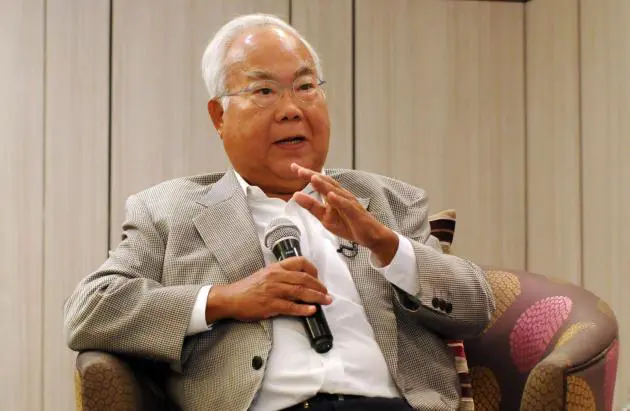


Chai-Anan Samudavanija, National Reform Council member, believes in reducing the role of national politics and emphasising the empowering of local municipalities, as that could curb corruption.
The NRC member for political reform proposed that the country should press on with decentralisation of power.
In an exclusive interview with The Nation, he said the country only needed a single Parliament of 77 members, with one elected MP from each province, no party-list MPs, and there was no need for the Senate.
Chai-Anan called for a pyramid-like political system with “a narrow top and a broader base”, referring to a shift in administrative power from the national government to local ones.
His reasoning for such a proposal is that it would be a more effective and convenient system in which ordinary people could take part.
“The fewer the MPs, the lesser the corruption. It is easier for the people to regulate and examine local affairs – because they are closer to the people – in comparison with national politics, which are generally perceived as far-reaching and complex,” Chai-Anan claimed.
The checks and balances duties performed by the Senate could be delegated to a committee of experts in various fields.
The distribution of administrative power to local municipalities raised concerns over the overlapping responsibilities between municipal and local administrations, together with the budget inefficiency from the over-complex layers of local administrative bodies, he said.
Chai-Anan suggested that local administrations be abolished, retaining only local municipalities.
No need for elected PM
or referendum
The former drafter of the so-called “1997 People’s charter”, declared his intention to stand for membership of the constitution drafting committee.
Chai-Anan has abundant experience in drafting constitutions and national reforms. He said a PM could be an elected or a non-elected MP, but he disagreed with the idea of having a directly elected PM.
Once the constitution had been drafted, he saw no need for a national referendum, because there weren’t any clearly conflicting issues.
“Usually, a referendum is required when opinions are split between alternative options; whether society wants A or B. However in the current situation, those alternative options aren’t apparent, therefore, a referendum is not necessary.”
“Public endorsement of the constitution can, instead, be demonstrated through the absence of public dissent,” he pointed out.
He said the national reform process would take many years and only a framework could be drawn up, cautioning people against expecting too much from the one-year period.
“The foundations of national reform can be put in place and there can be prioritisation of various issues in accordance with their urgency. We can prioritise which issues are more important so that we know what needs to be done first,” said the 70-year old former Constitutional Court judge.
He stressed that this period of one year was an important one when “people needed to participate as much as they could”, as the country’s future depended on current deliberations on the reform framework.
No guarantee for continuity
Once the new constitution comes into effect and a general election takes place, he said this NRC could not remain. In order to ensure continuity of the reform process, a new council should be appointed by the next elected government, he said.
He admitted that such continuity could not be guaranteed, as its fate rested on the political willingness of the next government.
“It is up to the [next] government, we should just focus on doing our best,”
Economic inequality
Another area of his passion is the economic inequality. He proposed that the central budget allocation be geared towards the poorest provinces.
The more wealthy provinces should receive lesser budget allocations. This would ensure that the money would go to where it was most needed and ease the inequality issues, which was not the case in the past.
