
Court drops lawsuit over GMO trial
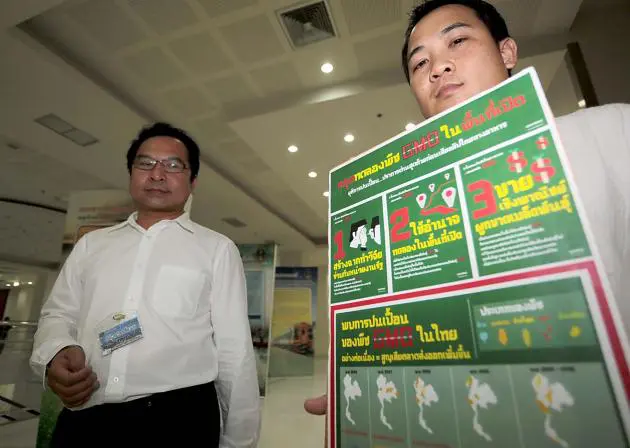


Greenpeace fears move will lead to more openair testing and crop contamination
AFTER MORE than a decade of court battles, the Supreme Administrative Court yesterday dismissed Greenpeace’s lawsuit against the Department of Agriculture (DOA) for alleged negligence in relation to a demonstration plot of genetically modified (GM) papaya, which had prompted fears of contaminated crops.
The move spurred a warning from Greenpeace that the DOA might use this as an excuse to push through more experiments on genetically modified organisms (GMO).
Yesterday’s verdict upheld the 2008 Central Administrative Court’s ruling that the DOA had taken necessary legal steps to curb widespread use of GMO plants, had cancelled the distribution of GM papaya seeds to farmers and took steps to eradicate GM papaya trees in 2004.
In 2006, Greenpeace filed a lawsuit against the DOA for alleged negligence in testing GM papaya at its research site in Khon Kaen province in 2004, which reportedly led to the contamination of nearby farms.
Unhappy with the Central Administrative Court’s ruling in 2008, in which the DOA and its then-chief were found not guilty, Greenpeace appealed to the Supreme Administrative Court claiming that there was no clear evidence whether GMO papaya trees and seeds had been completely destroyed.
Tara Buakamsri, Greenpeace Southeast Asia country director for Thailand, said this ruling did not mean that GMO contamination would go away. On the contrary, he noted that GMO contamination had affected several crops in different provinces over the past few years. He also voice concerns that the DOA will use this to seek legitimacy for conducting open-air GMO trials.
“This should be the biggest lesson for Thailand as it proves that GMO experiments in open fields cannot be controlled,” he said.
Greenpeace would continue to check on other crops that might be contaminated by GMOs nationwide.
According to a study by Biothai Foundation, GMO-contaminated plants – such as chilli, cotton and corn – were found in 13 provinces, including Nakhon Sawan, Lop Buri and Chiang Mai, between 2012 and 2013.
Greenpeace will later this month call on the military regime to cancel state support for GMO field trials in the country.
This move follows the Agriculture and Cooperatives Ministry’s recent announcement that it was looking to conduct a feasibility study to improve four economic crops, namely maize, cassava, palm and sugar cane, and will consider GMO options to boost production, control costs and cut down on pesticide usage.
DOA’s Biotechnology Research and Development Office chief Alongkorn Konthong is reportedly planning to ask the National Council for Peace and Order to lift Cabinet’s 2007 resolution banning GMO field trials anywhere but on government land. Tara warned that removing this ban would lead to widespread GMO contamination in the country.
“This would allow agricultural giants to easily join up with a government body and open the door to future testing,” he said. “GMO technology, developed to support corporate
