
Legal bid to suspend sale of fuel concessions


Play
Srisuwan appeals for court injunction against proposed bids for oil and gas concessions until reform sorted out
REFORM in the energy sector is caught in a bind, as rival groups are at loggerheads on the issue of new concessions – with the state agency rushing to grant drilling concessions and a civil society group heading to court to block the move until reforms are introduced.
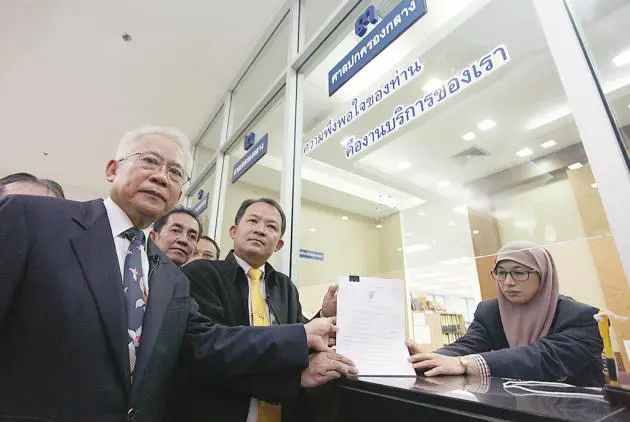
Activist Srisuwan Janya, along with more than 100 people, yesterday gathered and filed a petition at the Central Administrative Court, seeking an injunction against opening the 21st round of bidding for petroleum concessions.
The move came after the National Energy Policy Council (NEPC), at a meeting last week, approved the 21st round of bidding for petroleum concessions in 29 fields in 16 provinces, both on- and off-shore, which had been put on hold since 2012 because of the political turmoil.
“The energy belongs to all people, not to any group. The bidding for concessions should get a public hearing first so that the energy reform can be proceeded with efficiently,” said Srisuwan, president of the Stop Global Warming Association.
“I don’t think we have to hurry up the bidding for petroleum concessions. We should wait for discussions on this matter in the National Reform Commission first,” said Srisuwan, who is also secretary-general of the Constitution Protection Association.
Srisuwan yesterday sought an order from the Central Administrative Court to enforce the NEPC, Energy Minister and Department of Mineral Fuels’ director general to suspend or revoke the department’s announcement involving the opening of the 21st round of petroleum exploration and production.
The council is chaired by Prime Minister General Prayut Chan-o-cha.
It also asked the court to order the defendants to hold public hearings on the bidding. The defendants will also have to suspend or cancel the process of inviting tenders until the case is decided.
Meanwhile, Rosana Tositrakul, a National Reform Council member, recently said she disagreed with the opening of the 21st round of bidding for petroleum concessions. She feared this would open the nation’s energy resources to large energy firms, local and international.
She said Thailand had become like a condominium that was booked and traded by others, citing the trading of the country’s Nongyoa and Manora petroleum offshore fields in the Singapore market, which yielded a profit of Bt5 billion to one of the parties.
She questioned whether Thailand should maintain the concession system for petroleum auction.
Petroleum concession has been one of the hot issues in energy reform for a long time before the military coup toppled the previous government. Rosana, Srisuwan and many associates in civic groups have championed reform in the energy sector during protests against the previous government of Yingluck Shinawatra.
They have been disappointed that the pro-coup protesters and the junta did not have a policy different from the Yingluck government to allow a monopoly of energy by big firms.
Prime Minister Prayut had said earlier that it was necessary to open the bidding for petroleum concession because the exploration would take time. Many fields had drawn a blank. “The government cannot subsidise everything. If we did that [now it subsidises rice, gas and rubber prices], the country might be not be able to move forward,” he said.
