
Pot hits new ballot high, as America votes


Play
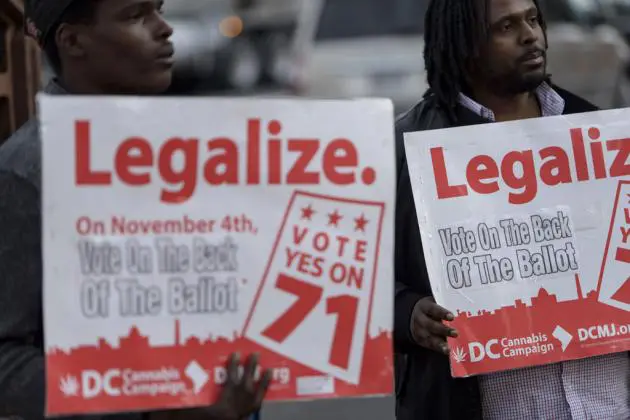
Washington DC and Oregon voted to legalise marijuana Tuesday, as across the United States ballots were held on issues ranging from gay marriage to bear-baiting, on the sidelines of midterm polls.
Oregon and the US federal capital provided a new high for the marijuana lobby, two years after two more western US states, Colorado and Washington, led the way in approving cannabis for recreational use.
In other referendum results, voters approved increases in the minimum wage in states including Arkansas, Illinois, Nebraska and South Dakota, according to partial results posted online.
On marijuana, Washington DC approved the measure by 65 per cent in favour and 28 per cent against, according to partial results posted online, while Oregon passed by 54 per cent to 46 per cent.
"More and more people are realising that it makes sense to choose licensed, regulated, and taxed marijuana businesses over the drug cartels," said Mike Elliott, head of the Colorado-based Marijuana Industry Group.
On the streets of the US capital, pro-marijuana campaigners were in jubilant form. "This is a great day for ending the war on drugs in the District of Columbia," said Malik Burnett, a leading campaigner.
"The District of Columbia was the birth place of the war on drugs, and marijuana prohibition was the engine of the war on drugs. Today we are putting the engine out of commission," he added.
Florida meanwhile appeared to have failed to approve a measure allowing marijuana for medical purposes. Some 57 per cent voted in favour, less than the 60 per cent required for the the proposal to pass, partial results showed.
Marijuana was just one subject being voted on, along with everything from abortion to gay marriage and GMOs to bear-baiting, in state and local referendums held in the sidelines of the US midterm elections.
Same-sex marriage, which is also in the process of being legalised by many US states, was put to a referendum in Arizona, which amended its constitution to outlaw it five years ago.
Another hot button issue, abortion, was on the ballot in Colorado, North Dakota and Tennessee.
In Colorado a proposal to define a foetus as a person was rejected by 64 per cent to 36 per cent of voters. In North Dakota pro-abortion voters also won by 64 per cent to 36 per cent.
Firearms measures were voted on in Alabama, Missouri and Washington state, where there were two opposing ballots: one making it tougher to buy a gun by imposing background checks, and the other seeking to ban exactly that measure.
Eight towns and cities voted on anti-fracking proposals. The extraction of oil and gas from shale via hydraulic fracturing has boosted US oil production, but critics fear its impact on the environment.
Several towns and cities voted on measures against Genetically Modified Organisms (GMOs). Referendums in the western US states of Oregon and Colorado sought to make it mandatory to label food containing GMOs.
On a lighter note, in California a measure proposed in San Francisco and Berkeley would impose a tax of one cent per centilitre on sugary beverages, in a bid to combat obesity and other health problems.
Voters in Alaska were consulted on a proposal to ban mining activity if it endangers wild salmon.
Also aiming to protect animals, the East Coast state of Maine was asked to ban bear-baiting, and in particular the use of cold pizza and donuts as lures.
