
High flying and high pressured 'Sky Doctors', new lifesavers of the North


Play
With less than perfect working conditions and no insurance in case of the unexpected, "sky doctors" and nurses and four related agencies are trying to provide aircraft to transport critical patients from the mountainous border province of Mae Hong Son t
Travelling from Mae Hong Son, through rugged mountains and notorious winding roads, can take hours to reach Maharaj Nakorn Chiang Mai Hospital (Suan Dok) or Nakhon Phing Hospital in Chiang Mai.
In the past, many patients succumbed on the way, Suan Dok deputy director Dr Narain Chotirosniramit said.
After the National Institute for Emergency Medicine (NIEM) was established, Narain, in his capacity as a NIEM committee member, stepped in to take care of the referral system in the North.
When NIEM signed a memorandum of understanding for air-transport for patients with the Royal Air Force, the Royal Thai Army, the Royal Thai Police, the Ministry of Natural Resources and Environment, and Chiang Mai operator Kan Air, the “Northern Sky Doctor” was set up.
Narain explained that in an emergency, NIEM is called to find an agency for a flight to transport a patient in need of urgent referral to a better-equipped hospital. NIEM would cover the transport expenses.
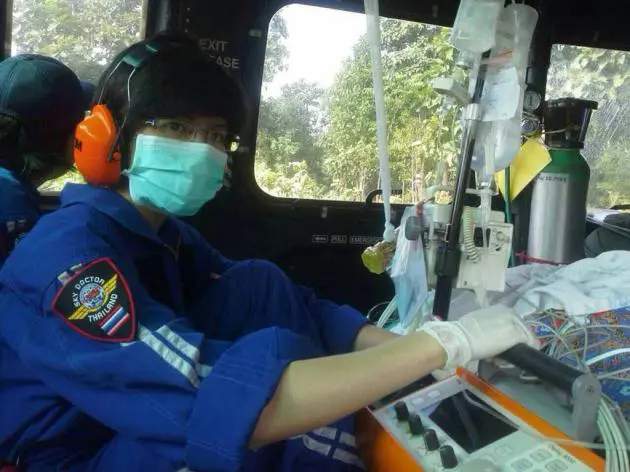
So far 20 doctors, nurses and medical personnel in both Chiang Mai and Mae Hong Son have been trained for the specialised and difficult patient care on aircraft.
“Mostly it would be a helicopter – we have a limited space and air pressure, engine noise can affect the patient. The smell of engine oil can also make any of us feel dizzy,” he said, adding that the medical team must learn to perform under such limited conditions.
Moreover, military aircraft do not provide life insurance for civilian passengers. If anything untoward happened, they would not get any cover – unless the medical staff were from a private facility with life insurance coverage.
“But we still go on board the aircraft to pick up patients, especially those suffering from heart disease, those critically injured from accidents, or new-borns,” Narain said.
The doctor said Mae Hong Son has no brain or heart specialists, so patients often need to be transported to Chiang Mai urgently.
“Delay can mean the loss of a patient’s life,” he said, adding that each such trip requires one doctor and two nurses.
“What most pressures us isn’t the lack of insurance but the fact that we have to compete with time. Sometimes we just cannot save the patient’s life – as in the recent case of a newborn with serious complications; no agency could provide a flight so the infant died. My team and I still feel sorry about that. Such limitations pressure us the most,” he said.
Narain said he hoped Thailand would in future have “sky doctor” teams with their own helicopters also equipped with ambulance-like medical equipment. Such a helicopter would cost about Bt450 million. Currently only one such medical helicopter is in use and it belongs to a private hospital in Bangkok.
