
JV on high-speed railway proposed


Play
Prayut happy with outcome of japan visit; says election expected in early 2016
THE GOVERNMENT yesterday proposed a joint-venture model to Japan for collaboration in building Thai railroads running high-speed trains, a system the prime minister said would be fruitful for the Kingdom and improve its people’s standard of living.
“We proposed a joint-venture model to Japan for collaboration on the construction of the [1.435-metre-gauge] railroads,” General Prayut Chan-o-cha said on the last day of his three-day visit to Japan.
The prime minister said he believed that if Thailand could build a high-speed rail network, it would be beneficial to the country in terms of trade, and would also benefit low-income earners. Areas along the rail lines, and areas around the stations, could be made commercial venues, he said.
On the rail-system project, both parties on Monday signed a memorandum of intent on the study and development of three routes – the “urgent” phase – which would connect both the East-West and North-South Economic Corridors.
One of these would be the route linking Myanmar’s Dawei Special Economic Zone to the eastern border areas of Thailand via Phu Nam Ron in Kanchanaburi, Bangkok, Chacho-engsao and Aranyaprathet district in Sa Kaew province.
Prayut commented on the matter yesterday after being briefed by Hiroshi Muto, vice minister for transport, tourism and international affairs at the Land, Infrastructure, Transport and Tourism Ministry, on Japan’s rail routes and rail-system development.
Muto also confirmed that Japanese experience and technology could be adopted for the development plan of the Thai rail system.
Meanwhile, Prayut, who marvelled at the advancement of Japanese technology, said Thailand planned to develop 1.435-metre tracks in the initial stage.
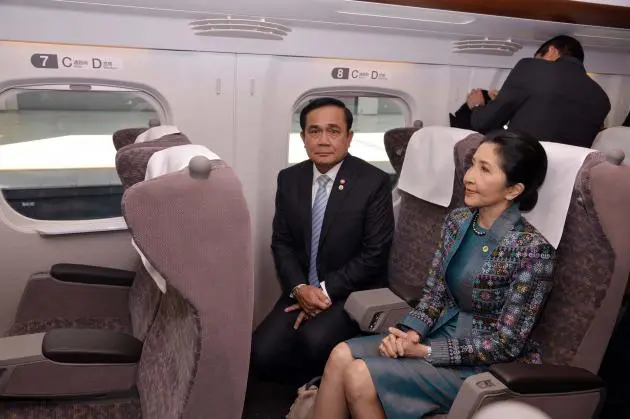
Shinkansen-type high-speed trains would be a future plan for Thai rail-system development, and would also depend on Japanese support, the PM said. After the briefing, Prayut and his delegation visited the Shinkansen Control Centre in Tokyo, before taking a ride on one of the “bullet trains” to Osaka.
The prime minister said he was pleased with what had been achieved during the three-day trip, during which the two nations held talks about cooperation in many dimensions, including a reduction in problems related to trade and investment, as well as finding ways to improve people’s standard of living.
Prayut also met with representatives of five private business organisations in Kansai – the Kansai Economic Federation, or Kankeiran – before flying back to Bangkok in the evening.
Kansai is one of Japan’s most important industrial zones, housing the headquarters of many large electronics and electrical firms, such as Sanyo Electronic, Konika Minolta, Mitsubishi Electric, Kyocera, Sharp and Panasonic.
As for the political situation, Prayut, who became prime minister after seizing power from an elected government, stressed to his Japanese hosts that progress was being made on the restoration of full democracy.
On behalf of the government and Thai people, he thanked the Japanese people for their concern about the political situation and said the constitution-drafting process was about to be completed – with a general election expected to be held early next year.
He added that his government was only assuming the role of state administration for a short transitional period, which he claimed was a crucial moment for the future of all Thai people.
The prime minister also gave an assurance that Thailand had been making an utmost effort in resolving its internal problems in a comprehensive manner, and would soon become a country with a sustainable and strong democracy.
