
New committee to ensure fair energy price structure


Play
Opponents of the 21st round of petroleum concession bidding and the government have agreed to set up a committee to ensure a fair energy price structure, National Reform Council member Rosana Tositrakul said yesterday.
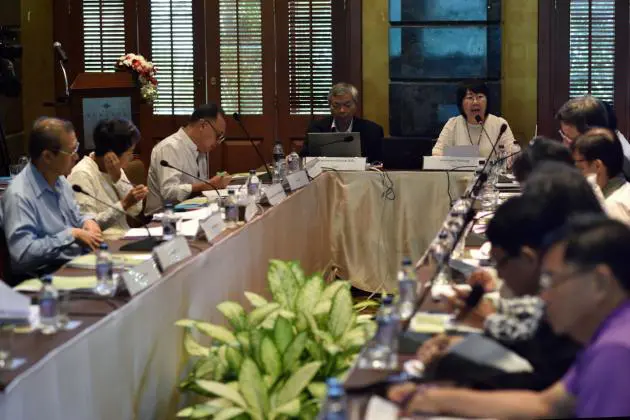
She was speaking at a seminar jointly organised by the NRC, the national reform panel and the Thailand Reform Institute (TRI) at Rangsit University.
She said the 21st round was strongly opposed because the public did not trust the state to ensure fair energy prices.
After a discussion between the concession opponents and the government agencies, both agreed to set up a committee to ensure fair energy prices and amend relevant laws such as the Petroleum Act 1971.
The Prayut Cabinet, on February 24, resolved that the 21st round needed to be delayed until the Petroleum Act was amended so that the state could enjoy more financial benefits.
The Cabinet agreed that the Act must be rewritten to include a profit-sharing scheme between investors and state agencies in petroleum deals. The current law authorises the government only to grant concessions to investors.
The move came after the government had met with strong resistance from opponents of petroleum concessions, led by Rosana.
She advised the government to switch to a production-sharing system, which she said would be more flexible and beneficial for the country.
Rosana said the government should concisely amend the law, survey potential new energy sources, or find more energy from current sources.
She called for the amendment to be completed during this administration’s tenure.
She said in order to determine the energy price structure, the following question must be answered: Should energy products be geared towards making profits or linked to the country’s basic infrastructure?
If the country wanted to make energy a basic infrastructure, energy prices must be low, as this would enable a low production cost for all goods.
“The current high energy prices have caused the prices of our goods to go high. Energy reform must be carried out by overhauling the sector entirely,” she said.
She also recommended that a national energy corporation be set up to manage the energy upstream business because the upstream resources must be controlled by the state while the mid stream and downstream should be given free competition. She insisted that the government switch from concession to a production-sharing system since the latter is more beneficial to the public.
Energy academic Prasart Meetaem said the important issues surrounding energy is not technology or cost but state policies. He criticised the state policies on energy that stalled national economic progress. He said to ensure fairness in energy price, the government must adopt democratic principles, free market and not monopoly. “Previous state energy policies just fence the sheep, making them unable find their own food,’’ he said.
He cited the solar energy policies, saying the cost of solar energy in many foreign countries was very cheap because of liberalisation. He said the NRC must give this issue top priority.
“The sun is our future because we can share the sun’s energy equally so no one should be given monopoly to use solar energy,’’ he said.
