
Narong's transfer not really a solution


Play
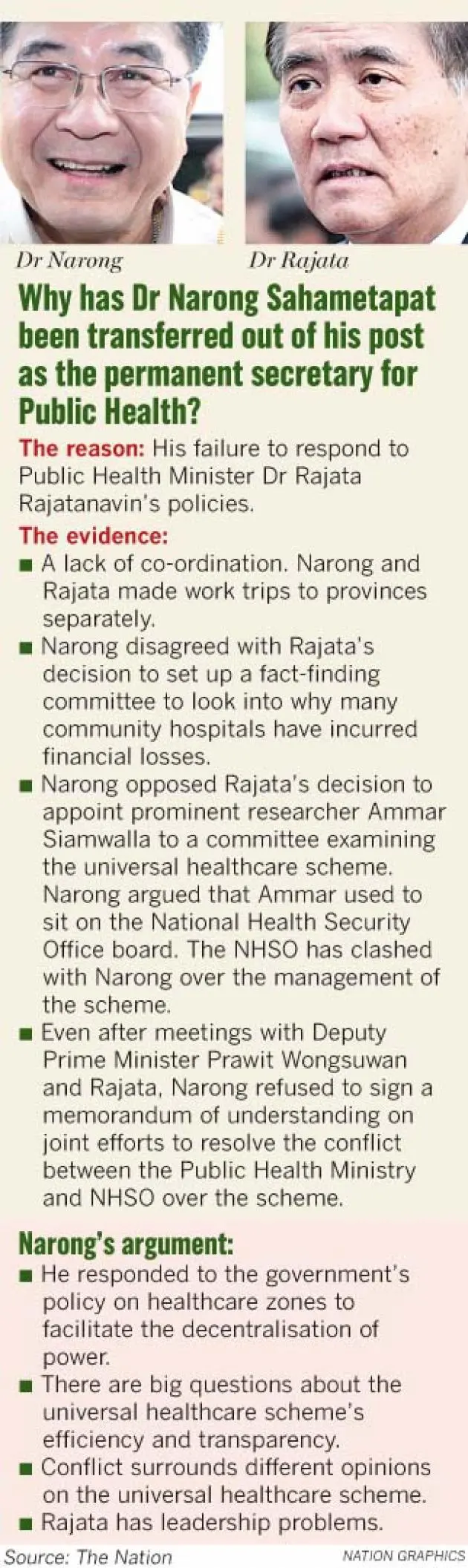
DR NARONG Sahametapat, the permanent secretary of the Public Health Ministry, has finally had to step down as the conflict over the universal healthcare scheme hit higher levels of intensity.
Word has been spreading since early this year that if Narong and Public Health Minister Rajata Rajatanavin failed to settle the conflict, one of them would lose his post.
Since Narong has shared this government’s stance against the previous elected administration, it appears that the authorities have tried not to be too harsh with him. Hence Prime Minister General Prayut Chan-o-cha just had him transferred to the Prime Minister’s Office pending investigation into his alleged failure to respond to government policies.
The probe will likely take some time, possibly long enough to let Narong retire at the end of October.
While the investigation continues, nobody will be appointed to take over his post at the ministry. His deputy Surachet Satitramai is temporarily filling the post as acting permanent secretary.
So if the government still cares about Narong, why has he been transferred?
The main reason for it might be Narong’s clash with the National Health Security Office (NHSO) over the management of the universal healthcare scheme and his uncompromising stance.
Last month, Narong did not show up for the signing of a memorandum of understanding on cooperation between the two sides in removing obstacles to implement the programme. This issue is a big deal, given that the scheme covers some 48 million Thais.
Concerns expressed
The government is obliged to ensure that the clash does not reach the point of disrupting the programme.
After all, many health networks have expressed concerns.
Led by Narong, state hospitals under the ministry’s supervision have stopped submitting reports on treatments provided under the programme to the NHSO.
These hospitals have also threatened to stop doubling as the scheme’s registrars.
They have resorted to these pressure tactics in a bid to press the NHSO into handing over the power to manage much of the programme as well as its budget.
Narong, however, has lamented that Thailand’s healthcare system has gone astray over the past 12 years because of the NHSO’s budget-oriented approach.
“It has focused on money first, rather than services,” he said.
In a bid to wrest control of the programme that has been operating under a yearly budget of well over Bt100 billion, Narong had started preparing by such things as establishing healthcare service areas.
The NHSO, however, has said it plays an important role as the buyer of the services so as to protect patients’ interest.
Both sides have their points, and both sides have their base of supporters. Hence it has been really difficult for Rajata to solve the matter himself.
When Narong refused to change his stance even after Deputy Prime Minister Prawit Wongsuwan summoned both him and Rajata to a meeting, instructing them to arrange negotiations, it seems the government had no choice but to move Narong from the ministry.
The transfer order promises to ease the heat in relation to running the universal healthcare scheme.
But it might just offer a respite, because the root cause of the problem still exists and sooner or later the conflict will rear its ugly head again.
