
Timely action needed to slow down climate change, French officials say


Play
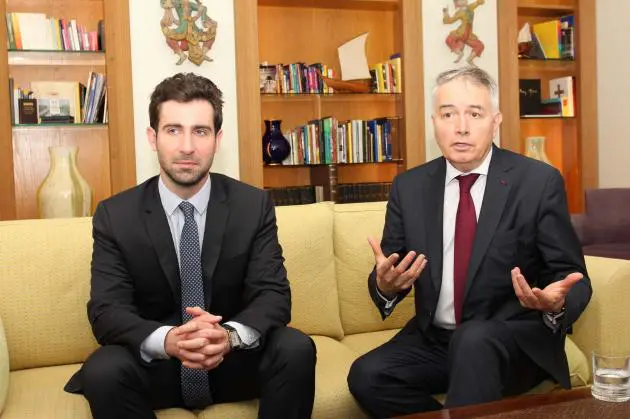
French Ambassador for the Climate Change Conference in Paris (COP 21) Philippe Zeller and COP 21 adviser Emmanuel Guerin, were in Bangkok to attend meetings recently. The pair spoke to The Nation's Wiraj Sripong on the readiness of Asean nations, especia
Q : WHAT IS THE MAIN OBJECTIVE OF YOUR VISIT TO BANGKOK AND TO ASIA?
Zeller: Our visit to Bangkok is part of the annual meeting of the French Ambassador in Asean. This will allow us to have an overview of the readiness of each Asean government for COP 21 in Paris.
We met with the director general of the International Organisation Department at the Foreign Ministry, Pornprapai Ganjanarintr, and Prasert Sirinapa, director of Climate Change Management and Coordination Division from the Environment and Natural Resources Ministry.
Q : HOW DO YOU PERCEIVE THE CURRENT PRACTICE FOR ENVIRONMENTAL PROTECTION IN ASEAN AND, IN PARTICULAR, THAILAND? WHAT RECOMMENDATIONS WOULD YOU GIVE?
Zeller: Given a large extent of forest that exists in Asean [approximately 213 million hectares across 10 Asean member states], this region is considered to be part of the “Earth’s lung”.
Our aim is to enable Asean nations to develop their economy and be able to preserve the environment at the same time. In so doing, a joint-effort among all stakeholders is of great importance to develop such practice.
For Thailand, it is crucial for the country to have a well-coordinated system among state agencies to enable a rapid and holistic approach to address the problem of climate change. Certainly, it will take time before things are adjusted, especially when it has to deal with inter-ministerial consultation and law implementation. Thailand has already advanced several plans and strategies at the national level that contribute to the spirit of environmental protection. For example, the National Master Plan for Climate Change (2011-2050) really highlights that climate change is a long-term priority.
At the regional level, Asean and its counterparts, particular Asean+3 and +6 could play a pivotal role in limiting the increase of [global] temperature. Given the importance of the agricultural sector that plays a big part in the region’s economy, biomass energy, hybrid systems, solar power and wind power should be considered as priorities for alternative energy.
Q : HOW WILL COP 21 IN PARIS HELP REDUCE THE DIFFERENCES BETWEEN ALL STAKEHOLDERS – BE IT AMONG STATES AND BETWEEN PUBLIC AND PRIVATE SECTORS?
Zeller: The top priority of this meeting is to reach a legally binding agreement that is acceptable to all stakeholders by focusing on the use of the existing frameworks and tools for cooperation. Each country will work on the “Intended Nationally Deter-mined Contribution” document to provide data about measures to mitigate and facilitate adequate adaptation to climate change. Everyone is at stake to keep global temperature rise at 2 degrees Celsius by 2020. The current trend indicates that everyone is conscious about the impact of climate change. Developed countries should take the lead in assisting the others to be on track via technical cooperation.
Guerin: COP 21 will enable the use of existing mechanisms such as the Green Climate Fund, Adaptation Committee and the Technology Executive Committee to realise an actionable project.
Q : AS CONCLUDING REMARKS HOW WOULD YOU EXPECT THE OUTCOME OF THE PARIS COP 21?
Zeller: The ultimate goal of this meeting is to move towards the creation of an actionable plan. If the spirit of Paris COP 21 is achieves to reach its ultimate goal, the result will certainly be fruitful. I do recognise that this may be perceived as being quite optimistic vis-a-vis the current situation. However, it is crucial to look further ahead. If all measures are undertaken in a timely manner, it will prevent climate conditions from further deterioration.
Guerin: Four factors have been envisaged to enable this conference to come up with a concrete outcome. They are the achievement of a |legal agreement, national contribution and commitment, ensuring budget support to all member states for realising this plan, and to utilise the “Agenda of Solutions” as channels to contribute to the resilience of economies and the development of structuring projects.
