
Stateless children still missing school


Play
One in 3 kids from Myanmar fail to get education: Unesco
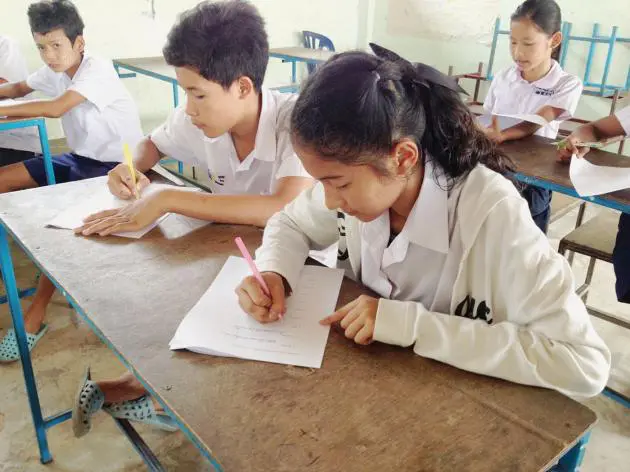
ABOUT ONE MILLION stateless children still have no access to the educational system in Thailand and, whilst the policy on this matter is clear, its implementation still has some way to go to be effective, academics and activists with non-|government organisations said last week.
If the policy were fully implemented, it could help prevent the issues of child labour and human trafficking, they said during a Bangkok seminar to review the past decade of Thai policy for education management for stateless children, and the next steps towards education for all people.
The seminar was organised by the Migrant Working Group (MWG), Save the Children, World Education, World Vision and the Office of Basic Education Commission (Obec).
Ichiro Miyazawa, programme specialist in Literacy and Lifelong Learning at Unesco (the UN Educational, Scientific and Cultural Organisation) said Thailand has largest number of migrant children in Asean.
There are some 3 million stateless persons in Thailand, and about 243,000 are out of school children as of 2009 he said.
Such a state of affairs could lead to long-term issues, such as economic impacts and social problems over the next 20 years, he said.
The upcoming Asean Economic Community’s (AEC) free flow of labour could also worsen problems over children’s education, he said, stressing that all related parties must therefore discuss the matter to find solutions and ensure all children get access to education.
Obec’s Policy and Planning Bureau director Payom Chinnawong said Thailand implemented a Cabinet resolution and an Education Ministry regulation that considered date of birth as adequate identification for stateless children to enter network schools, or to access the informal and non-formal education system.
But the curriculum must be adjusted to fit targeted groups, such as underprivileged children and disabled youths, more efficiently, he said.
However, he acknowledged the assessment emphasising that the Ordinary National Educational Test (O-Net) and the Advanced National Educational Test (A-Net) might not respond well yet to the demands of business establishments.
Equal opportunity crucial
Payom stressed that all children should be given equal opportunities, regardless of their nationality and identity.
World Education country director Patrick Kearns cited his organisation’s area survey findings that there are around 400,000 stateless children aged five to 15 in Thailand, about 90 per cent of whom were born to Myanmar parents in Thailand while others moved here with their parents from Myanmar.
Although the Cabinet’s July 5, 2005 resolution allowed stateless people to study at school, the issue regarding access still arose because many of these kids – especially those aged 11-14 – had to drop out to work and tend to their poor families, he said.
Even if the opportunity for these children to resume education was there, it was hard to materialise because most of these school dropouts would not return to the educational system, he said.
Kearns urged concerned parties to think of ways to keep such kids in the school until graduation, so they could use their certificates to get good jobs.
“Our job is to figure out the way to keep them in school until they reach the appropriate age to work,” he said.
The country director said that despite Thailand having a clear law and policy to allow stateless kids to access education, there was a lack of a good follow-up system, so many youths missed out on educational opportunities.
He went on to say that if stateless children could learn their mother tongue, it would be beneficial for them if they wished to return to their countries of origin.
He noted that implementation of good education management for stateless children could allow them to be independent and less likely to fall victim to human traffickers or people wanting to use child labour.
Migrant Working Group representative Roisai Wongsuban urged the Thai educational system to promote study for stateless children in their countries of origin.
She proposed that educational assessment be established in a way that lets children seamlessly |continue their study in their country of origin, while Thailand should also have a joint agreement with those countries about children’s education, which would result in clear and practical implementation.
The Thai Education Ministry should also have information about how many children from which countries of origin are in Thailand, so that those nations can pick up the reins and continue to provide them with an education, she said.
Hugh Delaney, chief of the Education Section at Unicef Thailand, pointed out the importance of stateless child labour in the Thai economy, since there was a large number of stateless children working in the Kingdom.
In the near future, the free flow of labour under the AEC will further highlight the necessity to educate these children, he said.
Therefore, cooperation between the private sector and the government was needed to provide educational equality, which would help such these children and the country’s future labour situation, he said.
