
Defer retirements if possible: NESDB


Play
Keeping mature workers on staff 'could help prevent grave economic impact'
PUTTING off retirement could be a solution to Thailand’s rapidly ageing society and the grave economic impact that may cause, while also addressing the worker-shortage issue, a new study has revealed.
The Office of the National Economic and Social Development Board yesterday presented its report on Thailand’s social development in the second quarter.
It encouraged seniors to remain in the workforce in order to help bring about positive social change.
It also urged the private sector to employ more senior citizens.
Transport minister and NESDB secretary-general Akom Termpitayapaisit suggested measures be implemented to boost the number of elderly people working in the private sector.
“The first thing we have to do is encourage the elderly to keep working after they reach retirement age, such as by creating jobs that suit the the elderly lifestyle and career paths,” Akom said.
“Moreover, there should be a lowering of employment barriers against the elderly by encouraging the business sector to have a good attitude towards senior workers and adjusting their working environments to suit them.”
He suggested law amendments to support elderly workers, developing a retirement money-saving system to encourage people to work longer and promoting a healthy lifestyle.
According to the National Statistical Office, Thailand’s population is ageing rapidly, with some 10 million seniors in 2014 – 14.9 per cent of population – compared to four million in 1991 – 6.8 per cent of the population.
By 2040 the number of senior citizens is forecast to grow to 20.5 million, or 32 per cent of the population.
The more a country’s population ages, the greater the dependence on social security. “This [seniors working beyond the retirement age] will be another way out for the growing aged population in the future, as statistics show that more seniors will not have enough daily income, and even the government offering more social security wouldn’t be enough,” Akom said.
The Thailand Development Research Institute forecast that by 2022 Thailand will have a supply of 42.5 million workers when 48.9 million is required. Having more seniors in the workforce would minimise the deficit.
“The promotion of the elderly working should be flexible and voluntary. The working style, working contracts, the positions and salary should be negotiable between the employer and employee. The government also should develop a system to help the elderly have jobs which suit them the most,” Akom said.
“The government acknowledged tackling the ageing society as one of its priorities in line with the 11th Economic and Social Development Plan and Older Persons Act,” he said. “But our work on the employment of senior citizen is still not very successful.”
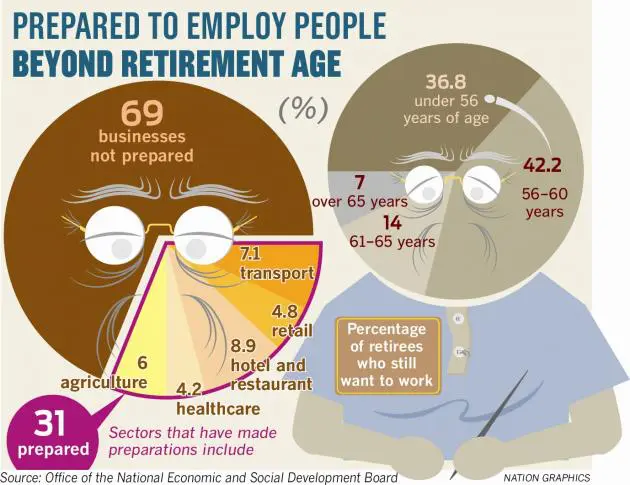
Workers in the private sector usually retire after the age of 56, though 42.2 per cent of them still want to continue working as per the NESDB study.
