
New charter is progressive, drafters say


Play
DRAFTERS of the new charter say it is far more progressive than the 1997 and 2007 versions, as it aims to empower the people to become "citizens".
“The foremost purpose of the draft is to reinforce citizens. We tried to get the people prepared to have important roles in the national administration,” said Pakorn Preeyakorn, spokesman of the Constitution Drafting Committee (CDC).
In a meeting with the press, Pakorn said the drafters didn’t just want people to hold power in the ballot box and pass it to politicians or officials. So, they added early in the charter that the sovereign power belongs to all Thais.
“The chapter on rights and liberty shows that all basic and other rights have been advanced. Thus, the draft is very progressive when it comes to granting rights to the people, especially on education and healthcare,” Pakorn said.
Asked how this would be realised, the drafters hinted that the fourth chapter on reform and reconciliation would be the mechanism to ensure implementation.
Pakorn urged people to read every part of the draft because it’s all connected and they will see how everything can truly be implemented.
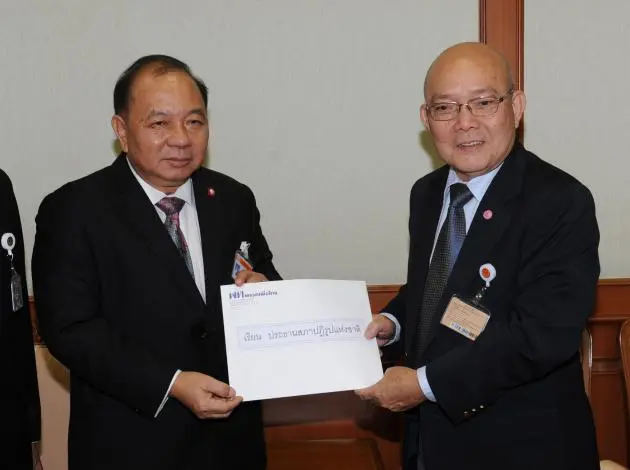
Pheu Thai representatives led by former Chiang Rai MP Samart Kaewmeechai submitted a letter to Thienchay Kiranandana, chief of the National Reform Council (NRC), to officially express the party’s opposition to the draft, which they claim would suppress the people.
Samart said the charter would weaken the elected government, which could not lead the country to reform as it would be dominated by other agents like the National Strategic Reform and Reconciliation Committee.
He said the party was ready to campaign against the charter if the law permits it. He asked the National Council for Peace and Order (NCPO) to open up more and listen to its opposition.
Natthawut Saikua, the leader of the anti-coup National United Front of Democracy Against Dictatorship, said some Cabinet members responded positively to the draft charter, suggesting that it’s what they wanted to see. But in his view, this charter goes against democratic principles. So, if it goes to a referendum, it’s likely that many people will campaign against it.
Wissanu Krea-ngam, a deputy prime minister, said people will just have to make up their minds because, in the first five years of the charter’s implementation, it will not be a fully-fledged democracy according to international standards. But he said the country would return to normal and the special powers would not be needed.
Wissanu said the charter drafters may have had the intention when they wrote the charter to prevent a coup as it would be more difficult to justify such a course as the committee would be there to resolve the crisis.
Compared with previous charters, he said, the new charter will close several loopholes left by old charters and will offer a way out of a political deadlock. For instance, the Constitution Court could receive an inquiry on constitutional issues and offer a solution to a deadlock, such as an inquiry about the resignation of a prime minister.
The special powers of the strategic committee, he added, would not be as powerful as feared as it would be subject to a system of checks and balances designed along with it, including a mixed bag of heads of administrative, legislative and some judicial branches.
The Portuguese, French and Spanish charters address similar situations, he said.
Wissanu reiterated that politicians would not be able to campaign against the charter, especially to invoke opposition and violence, but they could air their views on it.
