
Yingluck risks being counter-sued, says ex-judge


Play
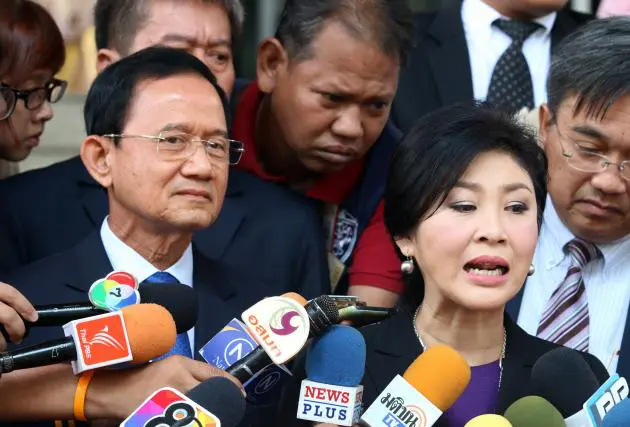
FORMER prime minister Yingluck Shinawatra risks getting slapped with a counter-suit for accusing a former attorney-general and three prosecutors of abuse of authority, former Supreme Court justice Chuchart Srisaeng said yesterday.
Yingluck could be charged with violating Article 175 of the Criminal Code for allegedly framing others and taking them to court, which is punishable by up to five years in jail, Chuchart posted on Facebook.
Yingluck’s legal team may be attempting to delay her trial at the Supreme Court’s Criminal Division for Political Office Holders over the rice-pledging scheme by filing the suit against the state attorneys, he said.
Meanwhile Norawit Lalaeng, one of Yingluck’s lawyers, defended himself against former attorney-general Trakul Winitnaiyapak’s comment on Facebook. “My father taught me that as a civil servant, I must practise tolerance and do my best to give my birthplace the gratitude I owe. For the rice-pledging scheme, I had to do my duty,” he wrote.
Norawit said Trakul failed to answer three questions:
Why did he not order an additional probe to fix holes in the case but signed on to indict Yingluck one hour before the National Legislative Assembly voted to impeach her?
Why did he indict Yingluck for consenting to corruption when the National Anti-Corruption Commission only accused her of negligence?
Why did he file 67,800 pages of documents with the suit even though they were not discussed during the investigation?
Deputy Prime Minister Wissanu Krea-ngam said he could not yet reveal the amount of compensation Yingluck has to pay for damages the state allegedly incurred from the rice-pledging subsidy programme even though the committees in charge of evaluating the damage figure have given him their report.
They had given him a formula to arrive at the figure and more calculation has to be done.
The government was not saying whether the rice-pledging programme was right or wrong, but since damage was incurred, someone has to take responsibility, Wissanu said.
“In the end, this will be settled in court. But instead of having the government take them to court, the government will be the defendant,” he said.
Deputy Prime Minister Wissanu Krea-ngam on Wednesday said he had received the assessment report on the value of damages to be used for civil liability actions against former Prime Minister Yingluck Shinawatra and others involved in the controversial rice-pledging scheme, previously expected to reach Bt500 million.
Wissanu said the two appointed committees had worked on three questions: had they committed any wrongdoing, who was responsible, and what was the estimated value of damages? These questions have been answered, Wissanu said.
The next step was for the committees to report to their respective ministers of Finance and Commerce, Wissanu said. Those ministers would then report to the prime minister, who would call a meeting to discuss the findings in detail. If everyone was in agreement, they would forward the report to the civil liability committee. The report would then be sent back to the PM and the two ministers to issue an administrative order against political holders and officials in accordance with the civil administrative procedures law.
A statute of limitation of two years would then be in effect, Wissanu added.
He said the defendants could challenge the value of damages by filing a complaint with the Administrative Court to revoke the order.
For the private entities involved in the case, of which 15 have been identified so far, the government will file a case in a normal civil court and the statute of limitation would be set at one year.
To file a lawsuit against the alleged wrongdoers, the first case must proceed so that the government could identify the principals responsible for such a large sum of damages.
Wissanu declined to confirm if the value of damages was close to the Bt500 million speculated.
Asked if the case would be over if Yingluck agreed to pay, he said it would be over if the civil liability was taken. If not, the government would enforce other civil liability actions to offset the financial losses incurred.

