
Angry farmers defy drought warnings, plant dry season rice


Play
Urge govt to be more generous with aid
FARMERS are growing a dry season rice crop – despite authorities’ warnings – and have urged the government to come up with concrete policies to help rice growers during the dry season.
As the dry season approaches, the Royal Irrigation Department (RID) has warned farmers in the Chao Phraya River Basin not to plant the dry season rice crop. They say the available water in the four major dams is not enough for agriculture. Officials suggest farmers cultivate fewer water-consuming plants – or change jobs and become labourers.
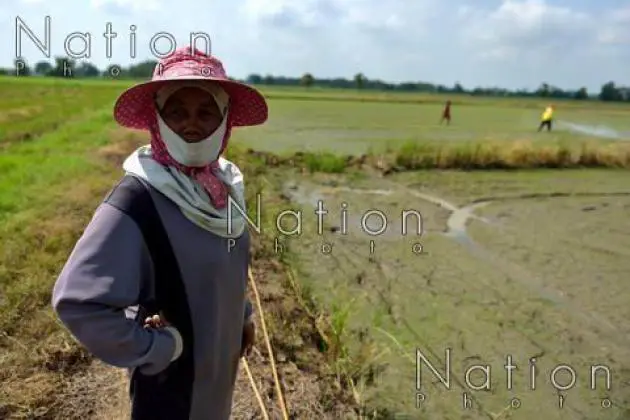
Wassana Gromtu, a farmer from Phitsanulok’s Bang Rakam district, sowed her dry season rice crop 15 days earlier, saying she had to disobey the RID warning because this was her only source of income to pay her debts.
“I rent five rai of paddy field for Bt1,000 per one rai of plantation. I have to invest Bt40,000 for seeds, fertiliser, pesticide, herbicide and petrol for water pumps. This is not including the daily expenses. We are farmers, so we have to plant rice as the main source of income,” Wassana said.
She said the measures offered by the government did not match the farmers’ needs. They wanted more substantial subsidies, such as compensation for crop failure or a debt moratorium for farmers.
“We are told to change jobs – to be workers or otherwise plant corn, vegetables or beans instead. This hurt my feelings so much. We are farmers – and furthermore, vegetables do not sell well and are cheap,” she said.

Phitsanulok Provincial Agriculture Office came out with four solutions for farmers during the dry season: seek jobs as daily workers; plant less-water-consuming crops; secure training in other skills; and process other agricultural products as sources of income.
Wassana said she would still grow rice throughout the next dry season even if there were no water from the irrigation system, as she had a well in her field. However, she admitted she was also concerned the drought might make her well run dry and destroy the crop.
Another farmer from Mueng Phitsanulok district, Duean Yangthapo, said the authorities could not dictate to him whether he could plant a dry season rice crop on his land.
“Earlier this year the RID lied to us when they said they would provide the water for us, but no water has come to my field. I know there is still water available but they shut the water gate to prevent the farmers from getting it,” Duean said angrily. He demanded the authorities be sincere with the farmers, as he was willing to comply with the authorities’ advice if they were frank about the water situation.
“The Provincial Agriculture Office advised us to plant less water-consuming plants – but I wonder if they will provide the water for us to grow these plants after all,” he said.
Duean owns 14 rai of paddy field, which will be ready to harvest next month. His field is located on the frequently flooded low-lying plain, which turned out to be beneficial during the drought.
There was still some water for the paddy field, while the other field on the high ground suffered heavily from water shortage during the earlier drought.
On the part of the authorities, Bandit Inta, head of the Phitsanulok Irrigation Project Office, revealed that RID had not ordered the farmers to stop planting a dry season rice crop. Instead, RID would inform the farmers about the scarcity of the available water and let them decide if they want to take the risk.
“By next Thursday, the RID local offices in the 3, 4, 10 and 11 districts within Chao Phraya River Basin will inform the farmers about the water situation and the relief measures,” Bandit said.
“Up until November, we expected we would have only 3,677 million cubic metres of available water in the four major dams. It is very certain they will not have enough water for agriculture,” he explained.
