
PM spells out action plan at '5 Rivers' meet


Play
PRIME MINISTER Prayut Chan-o-cha yesterday instructed the members of the "Five Rivers", who were meeting for the first time in their current format, to come up with a road map to facilitate reforms and to divide the work into phases.
He said his military-led government would work on the first phase of the reforms with relevant organisations, and the next government would handle the second phase in line with his 20-year strategic plan.
Prayut said the first phase of the reform work would mostly involve tackling immediate issues, such as government agencies’ inefficiency.
For more complicated issues concerning structural changes, the work would likely be handed over to the next government. He cited the example of the police reforms, one of the 37 reform agendas proposed by the now-defunct National Reform Council (NRC), which may extend into the second phase.
“The police reform may take five or 10 years or more than that,” Prayut said. “Maybe the next government will have to deal with that.”
Other phases will be implemented in line with the 20-year national strategy plan, he said, and it will be updated every five years.
The Five Rivers consists of the Constitution Drafting Committee (CDC), the National Reform Steering Assembly (NRSA), the Cabinet, the National Legislative Assembly (NLA) and the National Council for Peace and Order (NCPO).
Yesterday’s meeting was the first time the 21 members of the CDC had a chance to meet their counterparts in the NRSA, the NCPO, the NLA and the reshuffled Cabinet.
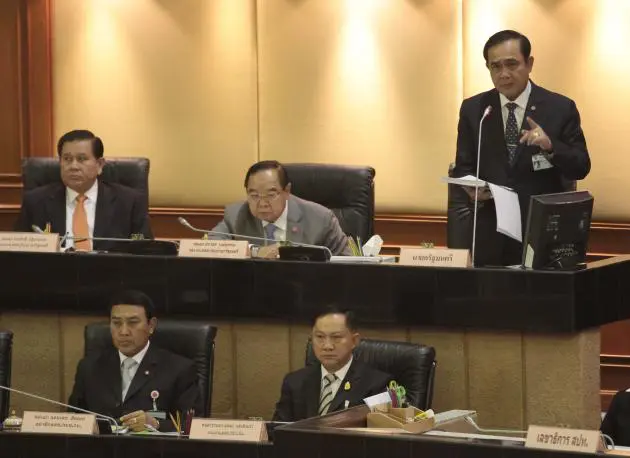
Although presided over by Pornpetch Wichitcholchai, the NLA president, the meeting was dominated by Prayut, who spent more than two hours explaining and updating national policies and orders in the hope that everyone present understood the working scenarios of the government and the NCPO.
He said a whip would soon be appointed to coordinate with the Cabinet and the NLA, and field trips would be organised to gauge the opinions of people on reforms and the new constitution.
During the meeting, the prime minister provided updates of the work done by the junta and the government, ranging from social programs to economic ones.
He also said he had come up with a mechanism to take immediate action against lese-majeste violators without the need for the usual “attitude adjustments”.
“With the previous cases, when I called violators in for attitude adjustments, some people said I was wrong [for doing so],” he said. “So when I find [lese majeste] offenders next time, I will not call them in any more but simply throw them in jail.”
The prime minister also insisted that there was no link between the Army’s cyberwarfare unit and the single Internet gateway. They would serve different functions, he said. The concept of the single gateway is still under study, while the cyberwarfare unit is certain to be set up to counter future cyber-threats.
Without mentioning any names, Prayut also urged fugitives from justice to return to the country so they can enter the justice process and attempt to prove themselves innocent. Prayut also urged them to “stop distorting facts.”
The PM asked for mutual understanding from all parties to respect and regard the rule of law so that the country can be united and progressive.
“It’s like our country was obstructed by a ‘flawed democracy’ river and everyone tried to cross it,” the general said. “Today, the NCPO, the government, the NRSA, the CDC are your bridge to cross over the conflicts. We need to have everyone walking on the bridge, so all of us can go over conflicts today.”, and have no more conflicts tomorrow,” he added.
A source at Government House said the prime minister wanted to impress upon all concerned agencies his intention to move forward with the reform work so everyone can go in the same direction.
Meanwhile, Alongkorn Ponlaboot, the NRSA vice president, told The Nation that he acknowledged Prayut’s directive and the NRSA would concentrate its work on developing an action plan for the NRC’s 37 agendas. It’s likely that other agendas concerning development would also be carried out in the second phase, he said.
