
CDC questioned over issues pertaining to Senate


Play
LEGISLATORS YESTERDAY cast doubts over senatorial matters in the charter draft, questioning especially the effectiveness of an indirect election of senators which would be explored along with a selection of senators during the transitional period.
There are fears this would lead to vote blocking and fail the system already addressed in the permanent chapter.
Reformers of the National Reform Steering Assembly (NRSA), meanwhile, expressed concern about the single-ballot system, deeming it more prone to vote-buying.
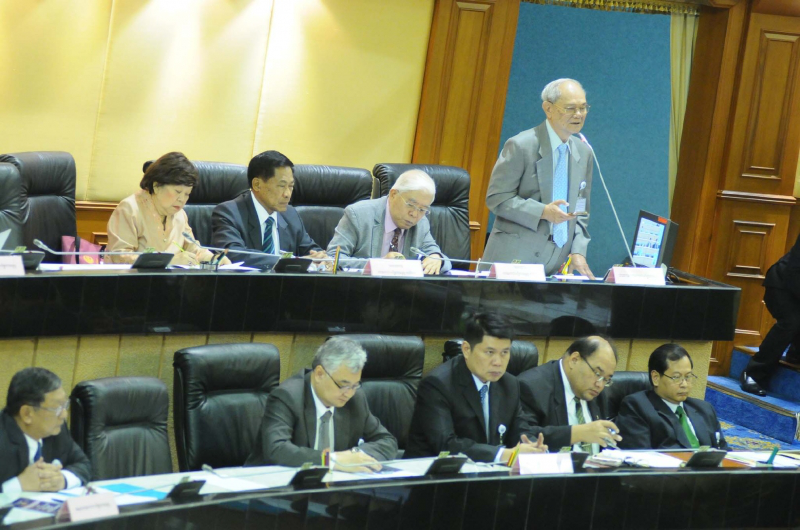
The Constitution Drafting Commission (CDC) met with the National Legislative Assembly (NLA), the NRSA, and the heads of governmental agencies yesterday to brief them on the completed constitution draft, which was submitted to the Cabinet on Tuesday.
CDC chief Meechai Ruchupan briefed them on the spirit of the charter draft, the content summary, as well as reasons for key controversial points including some exceptional rules applied during the five-year transitional period, including the mixed indirectly elected and selected Senate.
During the inquiry session, representatives of the NLA and the NRSA took turns to make further inquiries from the CDC although overall they appeared content with the charter draft.
The legislators were especially critical of the CDC’s decision to reserve 50 seats in the Senate during the transition period for indirectly elected senators, instead of all 250 selected senators as requested by the four rivers of power.
NLA members Somchai Sawangkarn and Tuang Annatachai expressed concern that cross-election at the local levels may not be very immaculate as such a method left a loophole for vote-blocking. In contrast, if selected by a selection committee, there would be better transparency.
“A wire-pulling game will be harder, if the entire Senate is selected by one selection committee,” Tuang said. “Also, what should we do [when we enter the permanent period after five years] if the cross-election method is proved to be ineffective?”
Another NLA member Jate Siratharanont questioned the impeachment power of the senators, which had not been addressed in the draft, saying the draft should have empowered the Senate with impeachment authority.
“The process is important. We do not necessarily have to successfully impeach them [corrupt politicians]. The point is to have them stand there, defend themselves, and have the media broadcast their responses,” he said.
The legislators also questioned how confident the CDC was that the same crisis would not repeat itself.
The drafters clarified that vote blocking among indirectly elected senators was not easy, provided the cross-election would take place at three levels – district to provincial and national.
Other than that, the constitution also set out rules to ban those committing electoral frauds for life, from running in any elections or holding any political office positions.
The CDC expressed confidence that all these measures could prevent foul play, which were at the root of the crisis facing the country. The CDC confirmed that in case the cross-election was really problematic, the charter could still be amended.
The drafters further explained that the senators could not impeach politicians because the Senate was not directly elected by the people.
However, they insisted that mechanisms to drive corrupt figures out of politics would not be short. They were in the hands of the courts and independent organisations, the CDC explained.
NRSA representatives, including NRSA’s political reform committee chair Seri Suwanpanont, voiced concern that the single-ballot system would result in rampant vote-buying.
They pointed out that the electoral system should have been a two-ballot system with larger constituencies. Bigger geographical areas for the election would make vote-buying difficult, Seri said.
However, the CDC insisted on its original intention that the single-ballot system would be good, as it ensured no votes would go in vain. In addition, they reiterated a lifetime ban would be imposed on those guilty of electoral fraud.
Parties whose members were involved with such a crime would lose points, they added. So, electoral candidates would not want to take a risk and buy votes.
The NRSA also complained that the CDC had shortened their terms in office from 12 months as originally promised to only four months. Meechai offered them apologies for not giving notice, citing they were short of time.
