
Blurring the lines


Play
PAWIT MAHASARINAND SPECIAL TO THE NATION Lyon, France
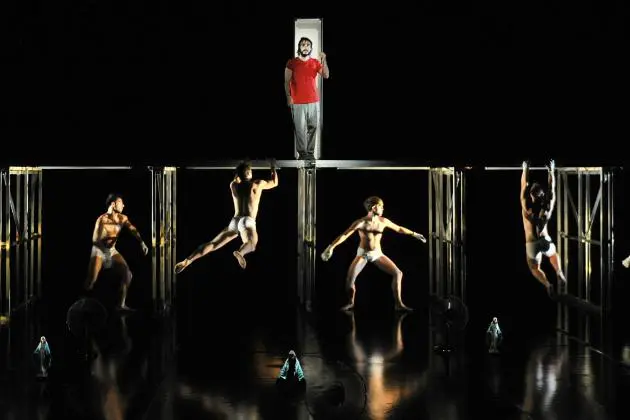
One of the world premieres at the 15th Biennale de la danse in Lyon was Ballet Preljocaj’s adaptation of Laurent Mauvignier’s novella “Ce que j’appelle oubli” (“What I Call Forgetting”). The story is based on a true incident in Lyon in which four supermarket security guards beat a young man to death simply because he hadn’t paid for a can of beer from which he was drinking.
Having watched many of internationally acclaimed dancer and choreographer Angelin Preljocaj’s works on DVD but never live on stage, I was thrilled not only by its strong social relevance but also by the fact that he chose to have a narrator speak the sentences of the novella out loud and English surtitles projected above the stage, while his dancers were moving – and they rarely competed with each other. I could see how other choreographers might have done it totally different, believing that physical movements can completely substitute for the spoken words.
The novella itself is unique to begin with – it doesn’t have a single full stop. It starts in the middle of a sentence with “and” and ends with “–”.“It’s presented in one single sentence, a long interminable sentence, which interweaves with the bodies’ sequence of movement and the literary structure in a radical way”, Preljocaj notes. Having worked with text in his dance works, including his famous solo “Le Fenumbule”, he seems no longer, in his words, “engrossed with the idea of dance, of movement without speech”, but has discovered that in some works, “a text can carry the body and be carried by it.”
Another happy marriage of dance and theatre, in a different direction, in the same festival was Groupe Rictus’s “Romeo et Juliette”. Director, choreographer and set designer David Bobee used a new French translation of the Bard’s classic tragedy, and his original English texts were projected above a stage that was entirely in copper. This colour scheme worked both as a political statement, as it reflected Islamic architecture and aesthetically, as the colour had unique effects with the lights. Most performers were of Arabic descent, because Bobee intended this production be “an echo of Israeli-Palestinian conflict, but without being literal about it.” Many of them were dancers. Whenever there was a dramaturgically logical opportunity for dance, such as in the fight scenes, they were so extensive and compelling that the audience might well have forgotten that it was originally written as a play. For example, the Capulet’s party at the beginning showcased a roof-raising acrobatic performance that also reflected the ongoing conflict between the two families. Another memorable scene was when the spirits of Mercutio and Tybalt rose from death and their duet, never seen in any adaptation of this classic, was a reminder that their feud would never cease.
“I don’t think in terms of disciplines – ever”, Bobee explains. “From the outset, my shows have had a blurred identity.”
Recently, I entered into an email debate with my boss whether to use the word dance or theatre to describe a festival we are co-curating. I proposed to use both so that it would cover various styles of works to be presented here and allow it to attract a wider audience., He insisted on only theatre partly because we are a theatre department. It is being called a theatre festival but notes the support from organisations like World Dance Alliance and Tanzconnexions.
With the line between dance and theatre blurring to non-existence, many universities around the world have merged their dance and theatre departments, and in some cases, have found a common term like “performance”. This will probably not happen soon here, though, as most of us still find ways to differentiate one from the other, rather than look for their common grounds which are natural and plentiful. And this is despite the fact that our performance traditions clearly show their inseparable nature.
The writer's trip was supported by the French Embassy in Thailand, Institut Fran
